Adobe has rolled out an integration connecting Anthropic’s Claude to its Creative Cloud suite, while simultaneously launching a public beta of its own Firefly AI Assistant. The two moves expand what users can do from inside a chatbot — but both carry access conditions that limit who benefits right away. Getting started requires a Claude account, and unlocking higher usage limits demands an Adobe subscription on top of that.
How the Adobe Claude AI Integration Actually Works
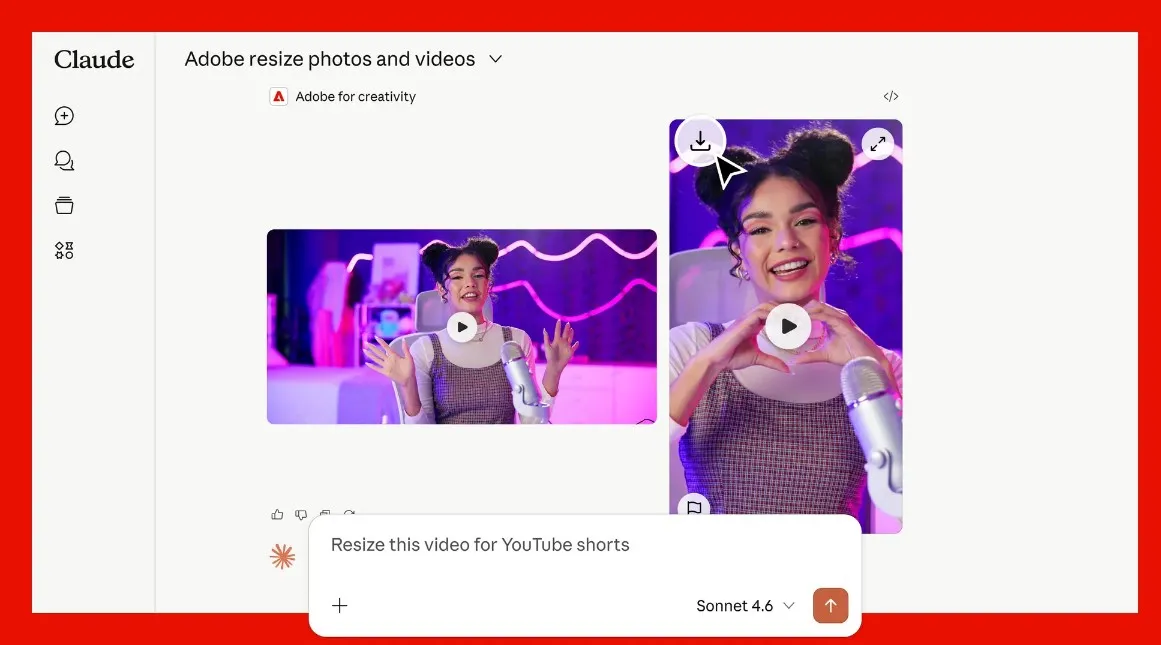
The Adobe for creativity connector lets Claude draw from more than seven Creative Cloud applications — Photoshop, Illustrator, Premiere, Lightroom, InDesign, Express, and Firefly — to execute tasks without users switching between programs. Adobe says the connector gives access to over 50 pro-grade tools across its ecosystem. According to PetaPixel, users describe their creative goals in plain language and Adobe’s systems coordinate the relevant tools automatically.
The connector covers practical production tasks: portrait retouching, social media asset creation, and video resizing for platforms like YouTube Shorts and Instagram Reels. According to The Verge, the connector is designed to bring images, videos, and designs to life inside Claude using assets pulled from Creative Cloud apps. Anthropic launched this alongside eight other connectors for tools including Blender, Ableton, Affinity, Autodesk Fusion, SketchUp, and Splice — part of a broader push toward creative professional workflows.
Adobe’s own Firefly AI Assistant entered public beta at the same time, available inside the Firefly web app. According to Axios, Adobe is also building a lighter-weight version of the assistant for use inside third-party chatbots, with Claude as the first target. Firefly AI Assistant includes pro-grade tools like Generative Fill and Replace Background, and Adobe says it is designed to handle both simple and complex creative pipelines while keeping users in control of final decisions.
Concrete Benefits and the Access Gaps That Come With Them
The Adobe Claude AI integration is not freely available to everyone. Users need an active Claude account just to get started — no account, no access. Higher usage limits and the full tool set require an Adobe account as well, meaning the workflow benefits are gated behind two separate subscriptions.
This matters most for the freelancers and small studios that the feature’s use cases seem designed for. Portrait retouching and social media asset creation are typical solo-operator workflows, but the access structure favors existing Creative Cloud subscribers who are already paying for Adobe’s ecosystem. New users exploring AI-assisted creation cannot simply try the connector without committing to at least one account first.
Firefly AI Assistant is in public beta, which means its feature set and reliability are still subject to change. Adobe frames it as capable of managing complex creative pipelines, but beta status signals that edge cases, errors, and missing functionality are still being resolved in 2026.
Claude Is Not the Only AI Pushing Into Creative Tools — and Adobe Knows It
Adobe’s timing is not accidental. Anthropic used the same announcement window to release nine creative connectors at once, positioning Claude as a coordination layer across software stacks that creative professionals already use. According to Cartoon Brew, Anthropic frames Claude as capable of supporting the full creative process — from early ideation through iteration to production-ready planning — a framing that puts it in direct competition with Adobe’s own Firefly assistant.
The overlap between the two systems is deliberate but creates an unusual dynamic. Adobe is simultaneously building its own agentic AI while integrating a rival AI into its apps. According to MacRumors, Anthropic says the connectors are designed to help creatives take on larger-scale projects — a value proposition Adobe’s own tools already claim.
Adobe has been adding AI features to its native apps for several years while also partnering with outside AI companies. The dual-track strategy reflects broader industry uncertainty about whether general-purpose AI assistants or application-specific agents will ultimately handle more of the production workload.
Open Questions Worth Tracking
Several questions remain unanswered as both integrations move forward. The most immediate is whether Adobe’s account requirement will limit adoption among independent creators who do not already subscribe to Creative Cloud — the very users who stand to benefit most from AI-assisted workflows.
The job market implications for creative professionals are also unresolved. Both Adobe and Anthropic describe their tools as expanding what individuals can accomplish, but the same capability that allows one person to handle portrait retouching, video resizing, and social media asset creation in a single session could reduce demand for specialists in each area.
Privacy and data handling remain open questions as well. Coordinating across Photoshop, Premiere, Lightroom, and other apps simultaneously raises questions about what data is accessed, retained, and potentially used to improve underlying models. Neither company has published detailed disclosures on this point in connection with the 2026 connector launch.
Finally, Firefly AI Assistant’s potential applications beyond creative production are still undefined. Adobe currently positions it as a creative industry tool, but an agent capable of coordinating multi-app pipelines could eventually be adapted for adjacent workflows in marketing, education, or media production — a market expansion Adobe has not yet addressed publicly.
FAQ – Frequently Asked Questions
Will the Adobe Claude AI integration be available for non-Creative Cloud applications?
While the current integration is limited to Creative Cloud apps, Anthropic has expressed interest in expanding Claude’s capabilities to other creative tools and platforms in the future. This could potentially include popular non-Adobe applications. Updates on this front are expected as part of Anthropic’s ongoing developer roadmap.
How will the Firefly AI Assistant’s beta status impact its performance and feature set?
As a public beta, Firefly AI Assistant is expected to receive regular updates and refinements, with new features and capabilities being added over the coming months. Adobe has committed to addressing user feedback and resolving edge cases, with a general availability release anticipated later in 2024 or early 2025.
Can users opt out of the AI-assisted features in Claude and Firefly if they prefer traditional workflows?
Yes, both Claude and Firefly are designed to allow users to toggle AI-assisted features on or off, depending on their workflow preferences. This flexibility enables creatives to leverage AI when it adds value while maintaining control over their traditional workflows.
Last Updated on May 3, 2026 6:56 pm by Laszlo Szabo / NowadAIs | Published on May 3, 2026 by Laszlo Szabo / NowadAIs