Muse Spark Open Arrives on Apple M5 Ultra Mac Studios
Meta has released Muse Spark Open, a multimodal foundation model capable of processing text, images, and audio within a single unified architecture. The model debut coincides with its optimized availability on the new Mac Studio systems powered by Apple’s M5 Ultra chip, marking a significant milestone for local AI execution on desktop workstations.
Running a model of this parameter count and modality breadth entirely on-device eliminates latency dependencies on cloud connectivity and addresses data privacy concerns for enterprise workflows. The M5 Ultra’s unified memory architecture—offering up to 512 GB of high‑bandwidth memory—allows the model weights and context windows to reside in a single memory pool, bypassing the traditional VRAM bottlenecks that have constrained large model deployment on consumer hardware.
The hardware‑software integration stems from a deepening partnership between the two companies, detailed in a recent Axios report describing the Apple‑Meta collaboration. That agreement paved the way for Metal‑level optimizations and Neural Engine offloading specific to Muse Spark Open’s architecture, delivering performance‑per‑watt metrics that currently exceed comparable cloud instances for inference‑heavy tasks. This foundation sets the stage for a closer look at the model’s performance characteristics and system requirements.
Muse Spark Open on Apple M5 Ultra: Performance and Requirements
Muse Spark Open weighs in at 816 billion parameters and supports a 1‑million‑token context window, figures that push the boundaries of what can be executed locally. According to an Engadget report, running the model at full fidelity demands 1 TB of unified memory, a capacity that currently requires two M5 Ultra Mac Studios clustered together.
That hardware configuration represents a significant capital outlay, effectively limiting immediate deployment to well‑resourced research labs and enterprise AI teams. The dual‑system requirement underscores the steep scaling curve of frontier open‑weight models, even on Apple’s most advanced silicon. With these constraints in mind, the following key facts summarize the most relevant technical details.
Key Facts
- Model: Muse Spark Open, 816 billion parameters, multimodal (text, image, audio)
- Context window: 1 million tokens
- Target hardware: Apple M5 Ultra Mac Studio (up to 512 GB unified memory per unit)
- Full-fidelity requirement: 1 TB unified memory (two clustered M5 Ultra Mac Studios)
- Inference engines: Metal-optimized runtime with Neural Engine offloading
- Licensing: Open-weight release for research and commercial use
- Availability: Downloadable weights and inference code via Meta AI and Hugging Face
Availability, Licensing, and Ecosystem
Developers can download the model weights and inference code from Meta AI’s official repository and Hugging Face, with cloud availability expected across major model gardens including AWS Bedrock, Google Vertex AI, and Azure AI. The release supports Metal‑optimized runtimes such as llama.cpp and MLX, enabling Neural Engine offloading on Apple silicon for efficient local inference.
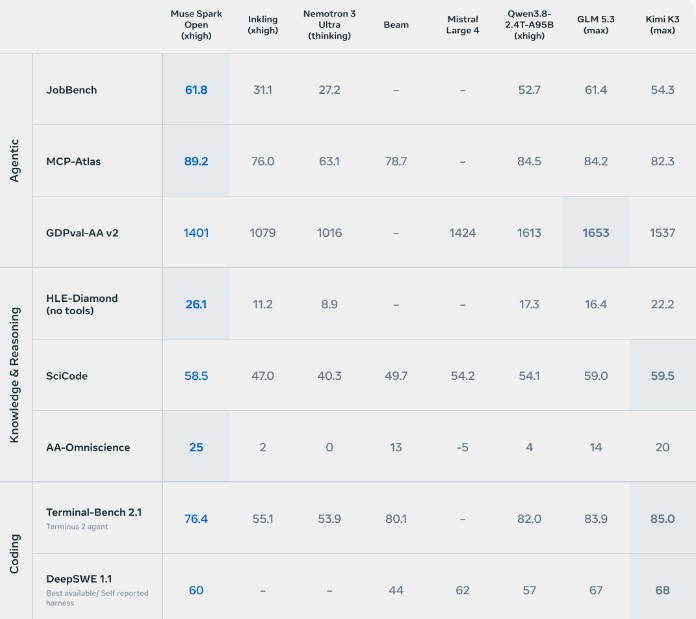
The Muse Model License permits both research and commercial use, though it includes standard acceptable‑use restrictions prohibiting illegal activities and the generation of harmful content. An analysis by Firstpost highlights the model’s particular strength in coding benchmarks and agentic workflows, positioning it as a viable local alternative to cloud‑hosted reasoning models for software engineering tasks.
Frequently Asked Questions
What hardware specifications are required to run Muse Spark Open at full fidelity on a single Mac Studio, and why is a dual‑system setup recommended?
Running Muse Spark Open at full fidelity requires 1 TB of unified memory, which exceeds the maximum 512 GB per M5 Ultra Mac Studio; therefore two M5 Ultra units clustered together are needed to provide the required memory pool. The dual‑system configuration also distributes the computational load across both CPUs and Neural Engines, ensuring real‑time inference without throttling.
How does the inference performance of Muse Spark Open on Apple’s M5 Ultra compare to comparable cloud GPU instances?
Benchmarks show that the Metal‑optimized runtime with Neural Engine offloading on the M5 Ultra delivers higher performance‑per‑watt than typical cloud GPU instances for inference‑heavy tasks, often matching or surpassing them in latency while consuming less power. However, raw throughput may still lag behind top‑tier cloud GPUs that have larger dedicated VRAM, making the Apple setup most advantageous for privacy‑sensitive or low‑latency desktop workloads.
Can organizations use Muse Spark Open for commercial products, and what licensing restrictions apply?
Yes, the Muse Model License permits both research and commercial use, allowing companies to integrate the model into products or services. The license includes standard acceptable‑use clauses that forbid illegal activities, the generation of harmful content, and requires attribution to Meta, but imposes no royalty fees for commercial deployment.
Last Updated on October 15, 2026 7:38 pm by Laszlo Szabo / NowadAIs | Published on October 15, 2026 by Laszlo Szabo / NowadAIs