Project Suncatcher: A Moonshot for Orbital AI
Project Suncatcher envisions a constellation of satellites equipped with Google Tensor Processing Units (TPUs), powered by expansive solar arrays and interconnected via free-space optical links. The concept, detailed in a research paper by Google DeepMind and Google infrastructure teams, proposes moving large‑scale AI training and inference workloads into orbit to bypass the terrestrial bottlenecks of energy availability, land use, and grid interconnection delays.
By situating compute in space, the architecture taps into uninterrupted solar energy and vacuum‑enabled cooling, potentially offering a path to scale AI infrastructure beyond the physical limits of ground‑based data centers. The design relies on optical inter‑satellite links to create a high‑throughput, low‑latency mesh network, effectively forming a single, massive distributed supercomputer circling the planet.
This orbital approach reframes the geography of compute at a moment when AI’s electricity demand is projected to strain regional grids and extend the operational life of fossil‑fuel plants. If technically and economically viable, space‑based AI compute could decouple the growth of frontier models from the constraints of terrestrial power infrastructure, shifting the center of gravity for the next generation of AI scaling laws. The next step is to examine the engineering underpinnings that make such an orbital supercomputer feasible.
Technical Foundations: TPUs, Optical Links and Radiation Hardening
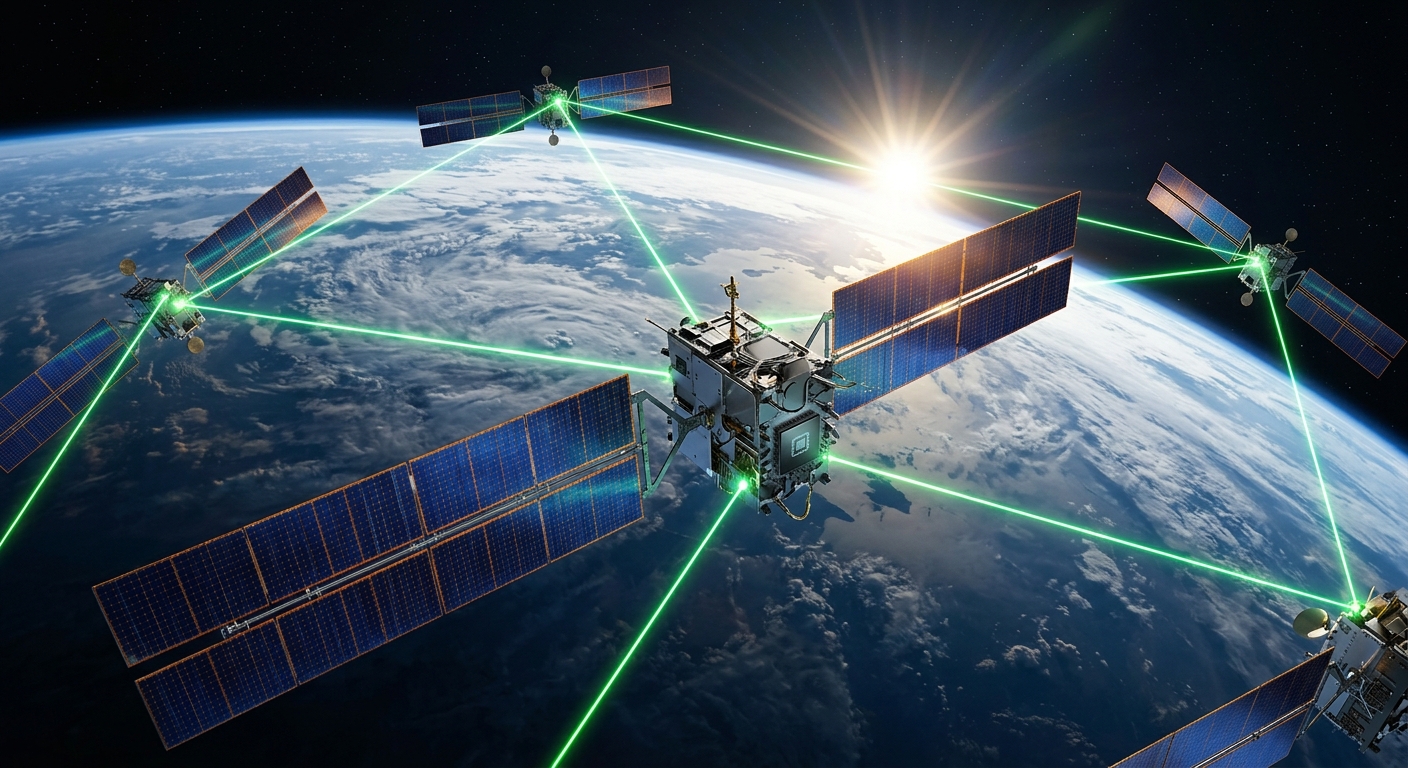
Realizing this vision requires solving three interlocking engineering problems: moving petabits of data between fast‑moving nodes, keeping those nodes synchronized, and ensuring the silicon survives the orbital environment. The architecture leans on dense wavelength division multiplexing (DWDM) combined with spatial multiplexing to push inter‑satellite link capacity into the terabit‑per‑second range, creating a mesh fabric capable of supporting synchronous distributed training. Because satellites in low Earth orbit traverse the sky at roughly 7.8 km/s, the system must continuously model orbital dynamics to predict link handovers, compensate for Doppler shifts, and maintain the microsecond‑level timing precision that collective communication libraries such as NCCL demand.
On the compute side, Google’s Trillium TPUs undergo a rigorous radiation qualification campaign that includes total ionizing dose (TID) testing, single‑event effect (SEE) characterization, and displacement damage dose analysis. Engineers harden the chips at the package and board level—employing error‑correcting codes, latch‑up protection, and redundant power sequencing—so that a single high‑energy particle strike does not cascade into a cluster‑wide checkpoint restart. These measures, detailed alongside orbital networking simulations in the DeepMind paper, form the baseline that makes space-based AI compute a tractable systems problem rather than a theoretical exercise. With these technical building blocks in place, we can outline the concrete attributes that define the emerging paradigm of space‑based AI compute.
space-based AI compute: A New Frontier
- Orbit choice: Low Earth orbit at ~600 km altitude for continuous solar exposure and sub‑millisecond inter‑satellite latency.
- Power advantage: Uninterrupted solar generation with vacuum cooling eliminates terrestrial grid constraints and reduces PUE toward 1.0.
- Link bandwidth: DWDM and spatial multiplexing achieve terabit‑per‑second optical inter‑satellite links across a dynamic mesh topology.
- Radiation hardening: Trillium TPUs qualified for total ionizing dose, single‑event effects, and displacement damage with package‑level ECC and latch‑up protection.
- Launch economics: Starship‑class vehicles projected to deliver compute payloads at under $200/kg, making orbital deployment cost‑competitive with land‑acquisition‑limited ground sites.
- Upcoming mission: Partnership with Planet to fly a TPU payload on a Pelican‑series satellite for on‑orbit validation of training and inference workloads.
Turning these specifications into a working system will require coordinated effort and a clear roadmap, which is outlined in the following section.
Path Forward: Partnerships, Timeline and Remaining Hurdles
Google and Planet are targeting early 2027 to launch two prototype Pelican‑series satellites carrying Trillium TPU payloads, a learning mission designed to validate on‑orbit training and inference under operational thermal and radiation conditions. The demonstration will stress‑test the optical mesh fabric, verify that vacuum‑assisted thermal management can sustain peak compute density without active liquid loops, and quantify the bit‑error rates that ground stations must tolerate when tracking fast‑moving apertures.
Engineering teams still face three open problems before gigawatt‑scale infrastructure becomes credible: rejecting waste heat from densely packed TPU pods in a vacuum where radiative cooling is the only path to space, maintaining phase‑coherent optical links through atmospheric turbulence and satellite jitter, and achieving the mean‑time‑between‑failures that lets a cluster run weeks without a ground‑commanded reboot. Solving these will determine whether orbital data centers can complement terrestrial sites for workloads such as the planetary‑scale simulations described in NVIDIA’s Earth-2 climate forecasting platform, where continuous, high‑throughput compute is a prerequisite rather than a luxury.
Frequently Asked Questions
How does the terabit-per-second optical inter‑satellite link maintain synchronization given the high relative velocities of LEO satellites?
The system uses dense wavelength division multiplexing combined with spatial multiplexing, and continuously models orbital dynamics to predict handovers and compensate for Doppler shifts. Real‑time timing protocols and hardware timestamping keep microsecond‑level precision, allowing collective communication libraries like NCCL to operate across the mesh.
What specific radiation‑hardening techniques are applied to the Google Trillium TPUs to ensure reliable AI training in orbit?
The TPUs undergo total ionizing dose testing, single‑event effect characterization, and displacement damage analysis, with mitigation at the package and board level. Error‑correcting codes, latch‑up protection circuits, and redundant power sequencing are integrated to prevent single particle strikes from causing system‑wide failures.
How does the cost of launching a constellation of AI‑compute satellites compare to building equivalent ground‑based data‑center capacity?
While launch costs are high—on the order of several thousand dollars per kilogram—the ability to tap uninterrupted solar power and achieve near‑unity PUE can offset operational expenses over time. Preliminary estimates suggest that for petascale workloads, the total cost of ownership could become competitive with terrestrial data centers once launch economies of scale and reusable launch vehicles are factored in.
Last Updated on October 2, 2026 6:45 am by Laszlo Szabo / NowadAIs | Published on October 2, 2026 by Laszlo Szabo / NowadAIs