NVIDIA’s AI Pivot Threatens Consumer Flagship
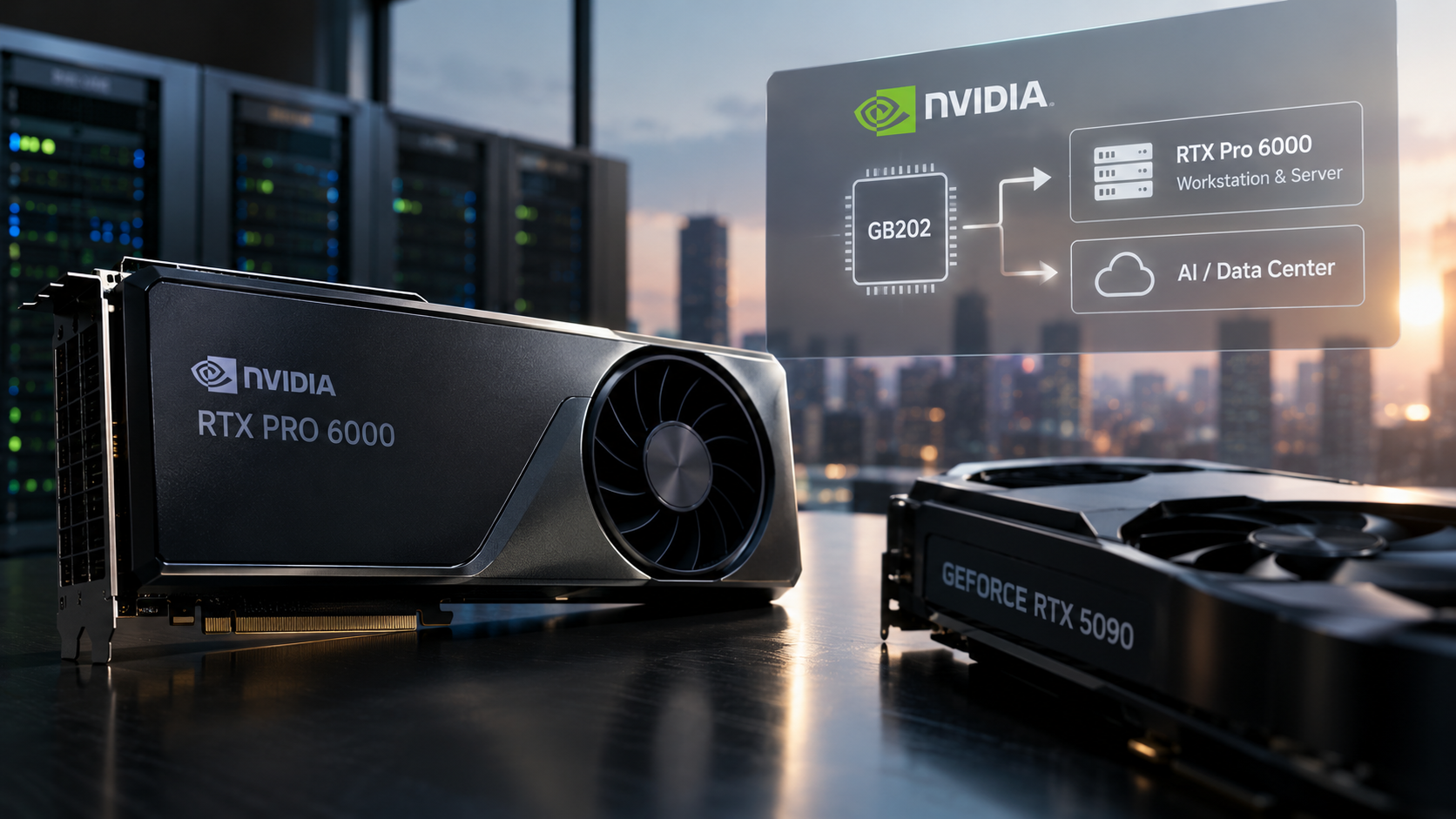
NVIDIA is reportedly preparing to discontinue the GeForce RTX 5090 discontinuation of its GB202 GPU die, redirecting that silicon toward the upcoming RTX Pro series and data center accelerators. According to a report from VideoCardz, the company aims to maximize yield allocation for high-margin professional and AI workloads, where demand continues to outstrip supply.
The move would effectively end the consumer flagship’s production run unusually early, leaving the RTX 5080 as the top-tier gaming card available new from NVIDIA. While the RTX 5090 launched only months ago, the strategic value of the GB202 die has shifted dramatically as enterprise customers compete aggressively for Blackwell architecture capacity. This shift in priority sets the stage for the next phase of NVIDIA’s product strategy.
GB202 Reallocation Powers RTX Pro 6000 Lineup
In response, NVIDIA is funneling the GB202 die directly into the new RTX Pro 6000 “Blackwell” workstation cards and corresponding server SKUs, where a single GPU commands a significantly higher average selling price than the consumer flagship. Tom’s Hardware analysis indicates that NVIDIA’s margin structure heavily favors these professional deployments, especially as enterprise buyers absorb available supply for large-scale AI inference and training clusters.
This reallocation creates a structural supply constraint for the gaming segment that cannot be resolved simply by increasing wafer starts at TSMC, as the sorting and validation bins for pro‑grade silicon differ from consumer requirements. The report suggests the impending supply drought will likely drive up secondary market pricing for the RTX 5090, while positioning a rumored RTX 5080 24 GB variant as the new de facto gaming flagship. The resulting supply constraints for gamers are summarized in the key points below.
Key Facts: GeForce RTX 5090 discontinuation
- NVIDIA is rumored to be moving the GeForce RTX 5090 to end-of-life status shortly after launch to prioritize GB202 die allocation for the RTX Pro series.
- The GB202 silicon is being redirected toward high-margin RTX Pro 6000 “Blackwell” workstation and server SKUs.
- Analysts expect the supply cutoff to drive significant price inflation on the secondary market for existing RTX 5090 inventory.
- A rumored GeForce RTX 5080 with 24 GB of VRAM is positioned to become the new de facto consumer gaming flagship.
- Shattered.io reports that the GB202 shift to RTX Pro is slated for 2026, formalizing the consumer lineup truncation according to their sources.
Broader AI Strategy and Market Outlook
Beyond the immediate product implications, NVIDIA’s broader AI strategy provides further context for these decisions. NVIDIA’s decision to truncate the consumer flagship lineup aligns with a broader corporate strategy that prioritizes enterprise AI infrastructure over gaming hardware. The company continues to pour resources into platforms like Earth‑2, its digital twin framework for climate simulation, which demands massive compute density and high-margin data center GPUs. By redirecting GB202 silicon toward RTX Pro and server SKUs, NVIDIA ensures its most advanced process technology serves the workloads driving its highest revenue growth.
This pivot reflects a market where the valuation premium attached to AI acceleration dwarfs that of consumer graphics. As hyperscalers and sovereign AI initiatives compete for limited leading-edge packaging capacity, the opportunity cost of allocating GB202 dies to a $1,999 gaming card becomes prohibitive. The rumored RTX 5080 24 GB variant serves as a strategic bridge, maintaining a presence in the enthusiast channel while the company’s engineering focus remains fixed on the data center roadmap.
Frequently Asked Questions
When is the RTX 5090 expected to be discontinued and how will that affect availability for gamers?
Industry sources suggest the RTX 5090 will be moved to end‑of‑life status in early 2026 as NVIDIA reallocates the GB202 die to professional GPUs. This early cut‑off will shrink the remaining production run, making new units scarce and pushing gamers toward the RTX 5080 as the top consumer card.
How does the performance of the rumored RTX 5080 24 GB compare to the RTX 5090, given the shift in silicon allocation?
The RTX 5080 is expected to use the same Blackwell architecture but with a slightly lower core count and power envelope than the RTX 5090, resulting in marginally lower raw rasterization performance. However, its larger 24 GB memory buffer may give it an edge in high‑resolution and AI‑assisted workloads where VRAM capacity matters.
What impact will the reallocation of GB202 silicon to the RTX Pro 6000 series have on the pricing of existing RTX 5090 units on the secondary market?
As NVIDIA diverts GB202 dies to higher‑margin RTX Pro and data‑center GPUs, the supply of RTX 5090 cards will tighten, driving up resale prices. Collectors and enthusiasts can expect secondary‑market premiums of 20‑30 % or more, especially for cards in good condition.
Last Updated on October 11, 2026 7:32 pm by Laszlo Szabo / NowadAIs | Published on October 11, 2026 by Laszlo Szabo / NowadAIs