AI video co-director: Google’s new multi‑agent framework for long‑form video
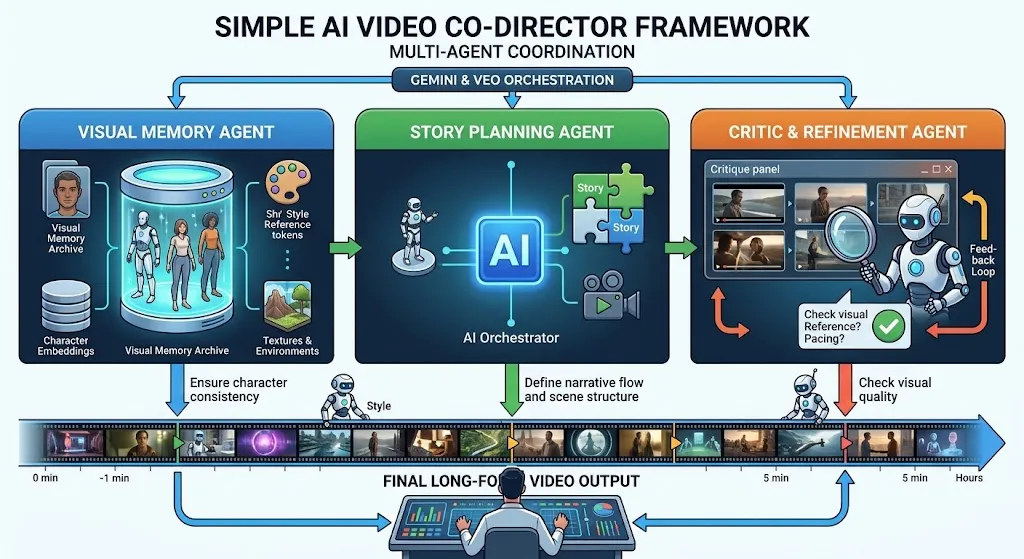
Google has introduced the AI video co-director as an orchestration layer that sits atop its Gemini and Veo models, coordinating multiple specialized agents to manage the complexities of long-form production. The system handles scene planning, character consistency, and temporal continuity across extended narratives — tasks that single-model approaches have struggled to resolve at scale.
By delegating responsibilities such as shot composition, style adherence, and narrative pacing to distinct agents, the framework aims to maintain visual coherence and story logic over minutes or hours of generated footage. Early research indicates the approach reduces hallucinated details and temporal flicker that typically accumulate in lengthy sequences. More details on the architecture and its integration with Gemini’s multimodal reasoning are available in Google’s technical disclosures. The following key facts summarize the core capabilities of this multi‑agent system.
Key Facts
- Multi-agent architecture coordinates specialized agents for scene planning, character consistency, and temporal continuity in long-form video generation.
- Framework operates as an orchestration layer atop Gemini and Veo models, translating high-level creative direction into frame-level synthesis instructions.
- Delegated responsibilities include shot composition, style adherence, and narrative pacing to maintain visual coherence across extended sequences.
- Early benchmarks show reduced hallucinated details and temporal flicker compared to single-model approaches for minutes-to-hours of footage.
- Leverages Gemini 3’s enhanced contextual understanding to interpret scripts, storyboards, and directorial intent with higher fidelity.
- Safety features include built-in content filtering at the agent level and consistency checks across the production pipeline to prevent policy violations.
Building on these fundamentals, Google’s architecture relies on three interlocking frameworks to achieve coherent storytelling.
How CANVAS, A²RD and VQQA enable coherent storytelling
The system relies on three interlocking frameworks. CANVAS (Consistent Audio-Visual Narrative Synthesis) acts as a persistent visual memory, storing character embeddings, environment descriptors, and style tokens so that every agent retrieves the same reference data when generating new shots. This shared state prevents the gradual drift in appearance and lighting that plagues single-pass generators.
A²RD (Agent-to-Agent Recursive Decomposition) breaks a script into discrete narrative segments and assigns each to a dedicated director agent. Agents negotiate boundary conditions — such as camera pose, emotional tone, and object placement — before rendering, ensuring that transitions between segments remain temporally smooth. The recursive hand‑off also allows earlier agents to revise their outputs when later segments reveal inconsistencies.
Finally, VQQA (Visual Quality Question Answering) provides a prompt-based refinement loop. A critic agent poses targeted questions — “Does the protagonist’s jacket match the reference frame?” — and the generator adjusts latent codes until the answer satisfies a learned quality threshold. Together, these components form a closed-loop pipeline that the technical paper describes as “iterative consensus” rather than one-shot synthesis. The approach mirrors the modular design philosophy seen in Google Opal’s agent orchestration, where specialized modules coordinate through explicit contracts instead of implicit latent alignment. These mechanisms together shape a new workflow for creators, redefining how video narratives are constructed.
Implications for creators and the future of AI‑driven video
The multi-agent architecture shifts the creator’s role from frame-by-frame prompt engineering to high-level creative direction, letting professionals define narrative arcs, visual style guides, and character bibles while the system handles shot-level execution and continuity enforcement. This abstraction layer could compress pre‑visualization and iteration cycles from days to hours, particularly for episodic content, branded series, and educational productions that demand consistent characters across dozens of scenes. Studios experimenting with the pipeline report that directors spend more time refining story beats and less time correcting temporal flicker or identity drift.
For independent creators, the orchestration model lowers the technical barrier to long-form synthesis by offloading consistency management to specialized agents rather than requiring manual latent‑space wrangling. The same agent contracts that govern CANVAS and A²RD also expose programmable hooks for custom style modules, asset libraries, and brand‑safety filters, suggesting an extensible platform rather than a closed product. Google’s parallel research into AI systems for longer, more consistent videos indicates this architecture will continue evolving toward real-time collaborative workflows where human editors and AI agents negotiate cuts, pacing, and visual continuity in a shared timeline.
Frequently Asked Questions
How does the AI video co-director maintain character consistency across long sequences compared to single‑model video generators?
The co‑director uses the CANVAS framework as a persistent visual memory that stores character embeddings and style tokens, which every specialized agent queries when creating new shots. This shared reference prevents drift in appearance and lighting, whereas single‑model tools generate each frame independently and often lose consistency over time.
What are the computational and latency implications of running the multi‑agent pipeline (CANVAS, A²RD, VQQA) for hour‑long video generation?
Each agent runs as a separate inference task on top of Gemini and Veo models, so the system requires multiple GPUs or TPU cores to parallelize scene planning, generation, and quality‑checking. While the orchestration adds overhead, the recursive hand‑offs and selective refinement typically keep end‑to‑end latency comparable to a single high‑capacity model, but the total compute cost is higher due to the multiple passes.
Can developers extend or replace components like the VQQA critic within Google’s AI video co‑director architecture, and what integration options are available?
Google provides an API layer that exposes the agent contracts, allowing developers to plug in custom critic modules or swap VQQA with alternative quality‑assessment models. The framework expects the replacement to adhere to the same prompt‑based question‑answer interface and to return a confidence score that the orchestration layer can use for iterative refinement.
Last Updated on September 25, 2026 7:36 pm by Laszlo Szabo / NowadAIs | Published on September 25, 2026 by Laszlo Szabo / NowadAIs