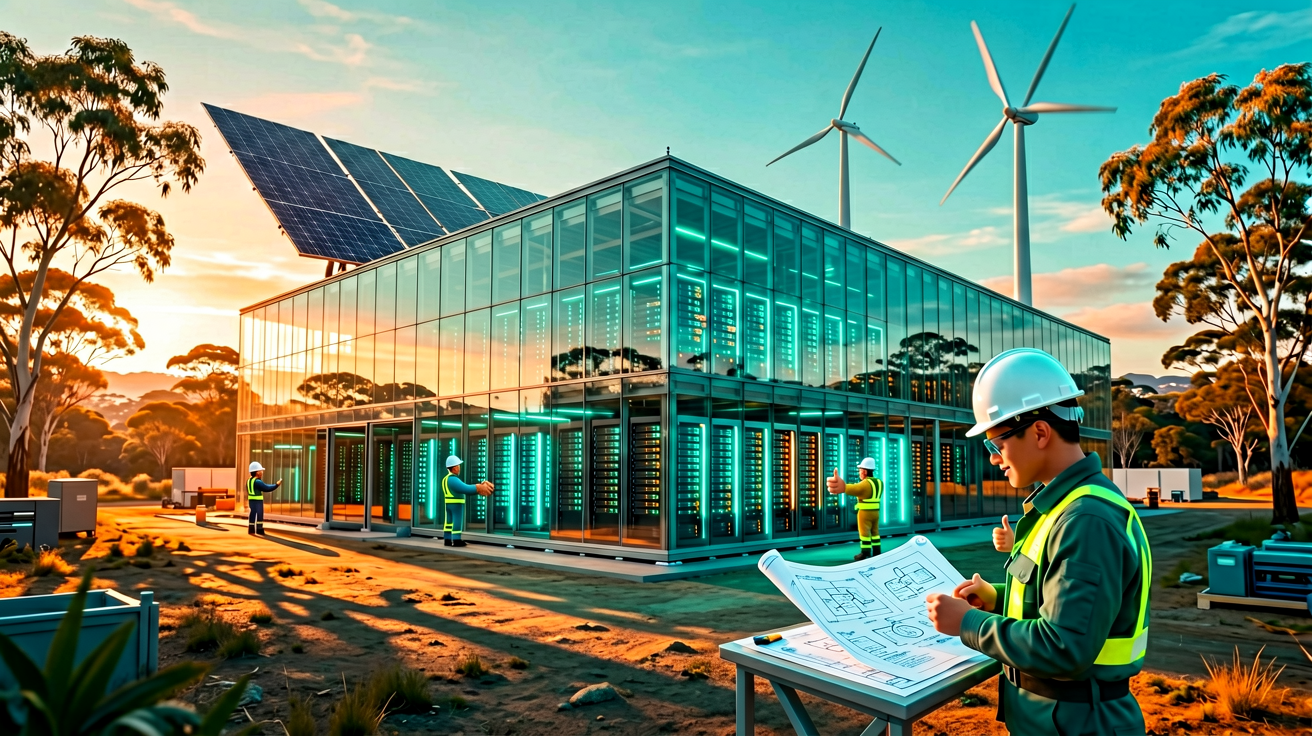
The $32B Deal: Anthropic Picks Queensland for Claude
Anthropic has selected Queensland’s Western Downs Digital Park near Dalby for its first Australian data centre, a facility designed to support the deployment of its Claude AI models. The project, to be constructed by Zerra DC, spans 725.5 hectares and carries a reported investment of $32 billion. Construction is slated to begin in 2027, with an expected build‑out period of four to six years.
Upon completion, the data centre will have a peak power demand of 2.16 gigawatts and an estimated daily energy draw of 47 gigawatt‑hours, reflecting the substantial computational requirements of large‑scale AI training and inference operations. The site’s location in Queensland’s renewable energy zone is intended to leverage access to low‑carbon power sources. These specifications set the stage for the detailed overview that follows.
Anthropic Claude Queensland data centre: Key Facts
- Deal size: $32 billion investment in the Western Downs Digital Park near Dalby.
- Location: Queensland’s Western Downs Digital Park, spanning 725.5 hectares.
- Power draw: Peak demand of 2.16 gigawatts, with an estimated daily energy use of 47 gigawatt‑hours.
- Jobs: Expected to create hundreds of construction and operational roles upon completion.
- Approval status: Construction slated to begin in 2027, pending final regulatory approvals.
- Function: Designed to run Claude models for inference, not AI training.
The sheer scale of power demand raises important questions about the region’s electricity grid, which we explore next.
Energy and Grid: The 2.16GW Question
The facility’s peak power demand of 2.16 gigawatts represents approximately 28% of Queensland’s total daily electricity consumption, raising significant questions about grid capacity and supply reliability. Recent policy changes have rolled back requirements for new large‑scale data centres to offset their energy use with renewable generation, meaning the Anthropic Claude Queensland data centre will initially rely heavily on the existing fossil‑fuel‑dominated grid until sufficient renewable infrastructure is built.
To mitigate immediate grid strain, the design includes on‑site battery storage systems intended to provide short‑term grid‑stabilisation services during peak load events. Additionally, the facility employs an air‑cooled thermal management system, which reduces water consumption but increases electrical load compared to liquid‑cooled alternatives, further amplifying its power draw implications for the regional network.
The Guardian reported that while the site is located within a designated renewable energy zone, the timeline for connecting to new wind and solar farms remains uncertain, leaving the data centre dependent on conventional power sources during its early operational years.
Beyond the technical challenges, the project has sparked a range of responses from local leaders and stakeholders.
Community and Political Reactions
Queensland Premier Steven Crisafulli welcomed the Anthropic Claude Queensland data centre as a transformative investment that will drive economic growth and technological advancement in the Western Downs region, emphasizing its potential job creation and infrastructure development.
Federal MP David Littleproud expressed cautious optimism, urging careful assessment of the project’s long‑term environmental and energy impacts while acknowledging its strategic importance for Australia’s AI capabilities.
Toowoomba Mayor Rebecca Smith highlighted the project’s potential to generate hundreds of construction and operational roles, though she stressed the need for workforce training programs to ensure local residents benefit directly.
Environmental group Save Our Darling Downs opposed the development, citing concerns over increased strain on the regional power grid, water resources, and the project’s reliance on fossil‑fuel‑based electricity during its initial operational phase.
A recent NYT/Siena poll found that 61% of US voters oppose the construction of new AI data centres, reflecting broader public apprehension about the energy demands and community impacts of such facilities.
Understanding the rationale behind Queensland’s selection helps contextualize these reactions.
Why Queensland? Anthropic’s Australian Strategy
Anthropic selected Queensland for its new data centre due to the region’s established renewable energy zones and proximity to major submarine cable landings, which support low‑latency connections to Asian and Pacific markets. The facility is designed primarily for inference workloads rather than model training, reflecting a strategic focus on deploying Claude models at scale for enterprise customers. This approach aligns with recent advancements in Claude Opus 4.5, which has shown strong performance in complex reasoning tasks and is increasingly adopted in sectors like finance and healthcare.
The move underscores Anthropic’s broader push into the Australian market, where demand for sovereign AI infrastructure is growing among government and private sector clients. Early adopters have already begun integrating Claude into operational workflows, as seen in Goldman Sachs’ use of the model for banking automation, highlighting its utility in streamlining legacy processes while maintaining compliance and security standards.
Frequently Asked Questions
How will the Anthropic Claude data centre meet its 2.16 GW peak power demand given Queensland’s current grid capacity?
The facility will initially draw heavily from the existing fossil‑fuel‑dominated grid, as the renewable energy zone’s new generation is not yet online. On‑site battery storage is planned to provide short‑term grid‑stabilisation during peak loads. Over time, additional wind and solar capacity in the region is expected to offset a larger share of the demand.
When is the data centre expected to connect to renewable energy sources within the Western Downs Digital Park?
The exact connection date is uncertain; the site is situated in a designated renewable energy zone, but the rollout of nearby wind and solar farms may take several years. During the early operational phase, the centre will rely primarily on conventional power, with renewable integration slated for later stages of the build‑out, likely after the initial construction period ends around 2031‑2033.
What cooling technology will the Queensland Claude AI inference facility use, and what are its implications for water and electricity use?
The centre will employ an air‑cooled thermal management system, which significantly reduces water consumption compared to liquid‑cooling solutions. However, air cooling increases the overall electrical load, contributing to the high 2.16 GW peak demand. This trade‑off aligns with the region’s water‑scarcity concerns but adds pressure on the power grid.
Last Updated on September 16, 2026 7:45 pm by Laszlo Szabo / NowadAIs | Published on September 16, 2026 by Laszlo Szabo / NowadAIs