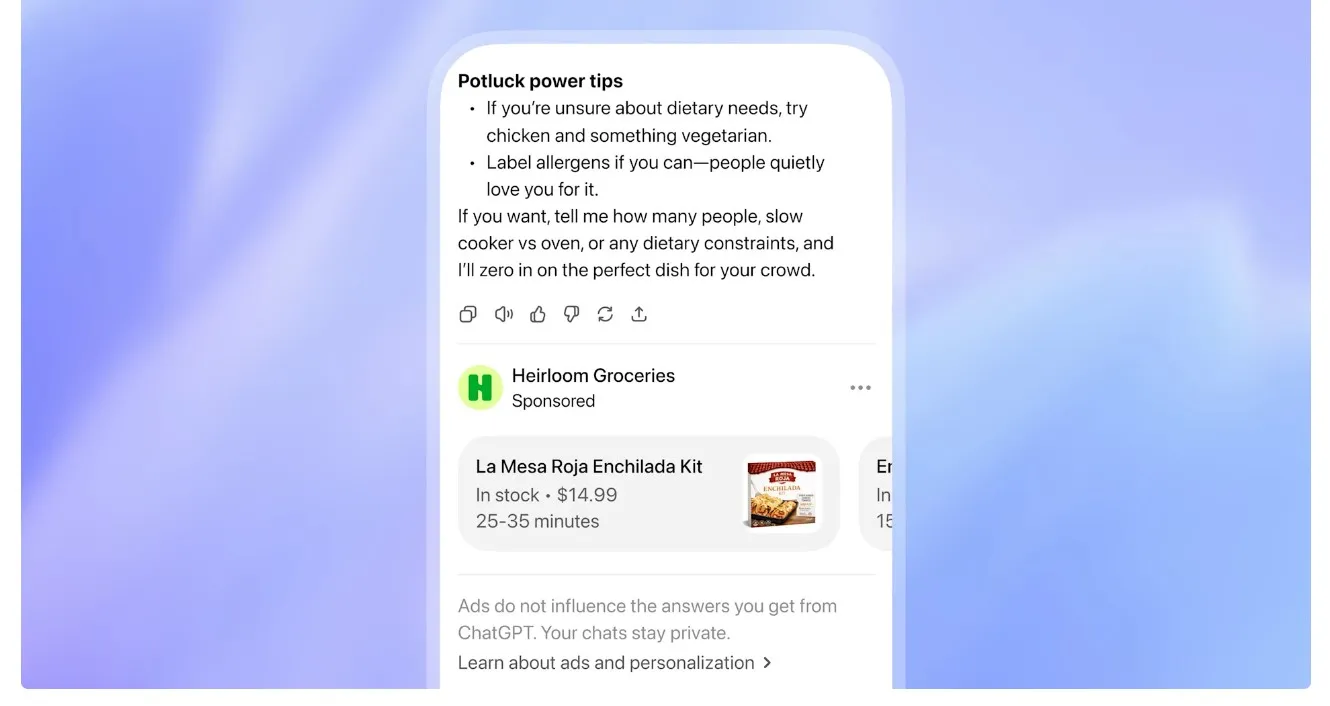
OpenAI is expanding its ChatGPT advertising pilot program to the United Kingdom, Mexico, Brazil, Japan, and South Korea within the coming weeks. The rollout follows an initial U.S. test and extends further to Canada, Australia, and New Zealand. Yet for the bulk of ChatGPT’s paying subscribers, the ads will not appear — by design.
ChatGPT Advertising Pilot Program Reaches Five New Regions
According to Adweek, OpenAI confirmed the expansion on May 7, citing strong interest from businesses seeking to reach users in a conversational, intent-driven environment. David Dugan — a longtime Meta ads executive who now leads OpenAI’s global ads solutions — announced the move in a statement. The pilot timeline has already been extended beyond its original March end date, suggesting OpenAI is treating this as a long-term build rather than a short experiment.
OpenAI says hundreds of millions of people use ChatGPT for learning, work, and everyday decisions — a scale that makes the platform attractive to advertisers looking for reach outside traditional search and social channels. Businesses can sign up for updates at openai.com/advertisers/. The company has also published its principles for how ads are placed and matched at our-approach-to-advertising-and-expanding-access.
Free-Tier Users Are the Inventory — Everyone Else Is Excluded
ChatGPT currently offers seven subscription tiers: Free, Go, Plus, Pro, Business, Enterprise, and Education. OpenAI’s stated policy bars ads from appearing on Plus, Pro, Business, Enterprise, and Education accounts — which means only Free and Go users are part of the addressable audience. For advertisers accustomed to platform-wide reach, that is a hard ceiling on available inventory.
The exclusions extend further. OpenAI says ads will not be shown in accounts where the user indicates or the platform predicts they are under 18. Ads are also blocked from appearing near sensitive or regulated topics, including health, mental health, and politics. Together, these guardrails carve out a narrower slice of conversations than a raw user count implies.
Targeting is contextual rather than profile-based: if a user is researching recipes, for instance, they may see ads for meal kits or grocery delivery. Example advertiser Heirloom Groceries illustrates the type of brand OpenAI says fits this environment. OpenAI frames this as privacy-preserving, but it also means advertisers get less behavioral data depth than they would on incumbent platforms.
The Ad Industry Is Already Moving
StackAdapt, an AI advertising and orchestration platform, announced it is offering advertisers early access to ChatGPT ads as a technology partner, positioning itself to help shape the channel as it develops. Major retail brands — including Albertsons, Target, and Williams-Sonoma — have already joined the pilot, according to MediaPost. Agency group WPP Media has also confirmed it will support client tests on the platform.
Early field observations have already overturned some assumptions. According to MediaPost, Expedia’s sponsored ads — centered on last-minute weekend getaways — triggered on the very first user query, not after an extended dialogue as many had expected. That changes how advertisers should think about frequency, creative context, and message sequencing inside this channel.
On the infrastructure side, OpenAI opened its ad platform to cost-per-click bidding on May 6 and launched a self-serve Ads Manager in beta, allowing U.S. advertisers to upload creative, set budgets, control pacing, and track campaign performance. As Search Engine Journal reports, the new platform also includes conversion tracking and measurement tools that were absent during the first phase of the pilot.
What Advertisers and Users Should Watch Next
Whether the contextual matching model holds up over time is an open question. OpenAI has not detailed how it plans to manage ad fatigue among Free and Go users who rely on ChatGPT daily for substantive tasks. The longer and more frequent the sessions, the more ad exposures accumulate — and the harder it becomes to sustain the intent-match quality the company is using as its core pitch to advertisers.
The buying model itself is still evolving. OpenAI says it is using advertiser feedback to determine what additional formats, objectives, and buying options to add as the program matures. CPC bidding is now live, but whether broader programmatic access, video formats, or performance-driven objectives follow — and on what timeline — has not been confirmed. Those decisions will determine whether the ChatGPT advertising pilot program earns a meaningful line in media plans or remains a test-and-learn allocation for the foreseeable future.
For decision-makers sizing up the opportunity, the most useful frame is not the headline expansion. It is the excluded majority: when five out of seven subscription tiers see no ads at all, the reachable audience is structurally smaller than the platform’s total user count suggests — and that gap deserves to sit at the center of any budget conversation.
FAQ – Frequently Asked Questions
How will OpenAI handle ad fatigue among frequent ChatGPT users?
OpenAI plans to implement a frequency capping mechanism to limit the number of ads displayed to individual users within a certain time frame, mitigating ad fatigue. This feature is expected to roll out in the next phase of the pilot program. Additionally, users will have the option to provide feedback on the relevance and intrusiveness of ads.
Can advertisers target specific ChatGPT user behaviors or interests outside of contextual targeting?
While OpenAI’s current ad platform focuses on contextual targeting, the company is exploring the development of more advanced targeting capabilities that balance user privacy with advertiser needs. These potential future features may include lookalike targeting or custom audience segments based on aggregated user behavior.
What metrics will OpenAI use to measure the success of its ad pilot program?
OpenAI will track key performance indicators such as click-through rates, conversion rates, and return on ad spend to evaluate the effectiveness of its ad platform. The company will also conduct regular surveys to gauge user satisfaction with the ad experience and gather feedback from advertisers on platform usability and feature requests.
Last Updated on May 7, 2026 8:03 pm by Laszlo Szabo / NowadAIs | Published on May 7, 2026 by Laszlo Szabo / NowadAIs