Meta Muse AI assistant: What You Need to Know
Meta has launched Muse, a personal AI agent designed to operate across its family of apps including WhatsApp, Instagram, and Messenger. The company positions the assistant as a proactive tool capable of managing complex, multi-step tasks such as trip planning, calendar management, and creative brainstorming without requiring constant user prompting. Built on the Llama 4 architecture, Muse integrates long-term memory and tool use to maintain context across sessions and platforms.
Early hands-on testing suggests the agent distinguishes itself through deep integration with Meta’s social graph, allowing it to surface relevant contacts and historical interactions when executing requests. A first-hand review noted that while Muse handles asynchronous workflows effectively, its reliance on the Meta ecosystem creates friction for users heavily invested in competing productivity suites. These capabilities set the stage for how Muse constructs detailed relationship profiles, a process we explore next.
How Muse Builds Relationship Profiles
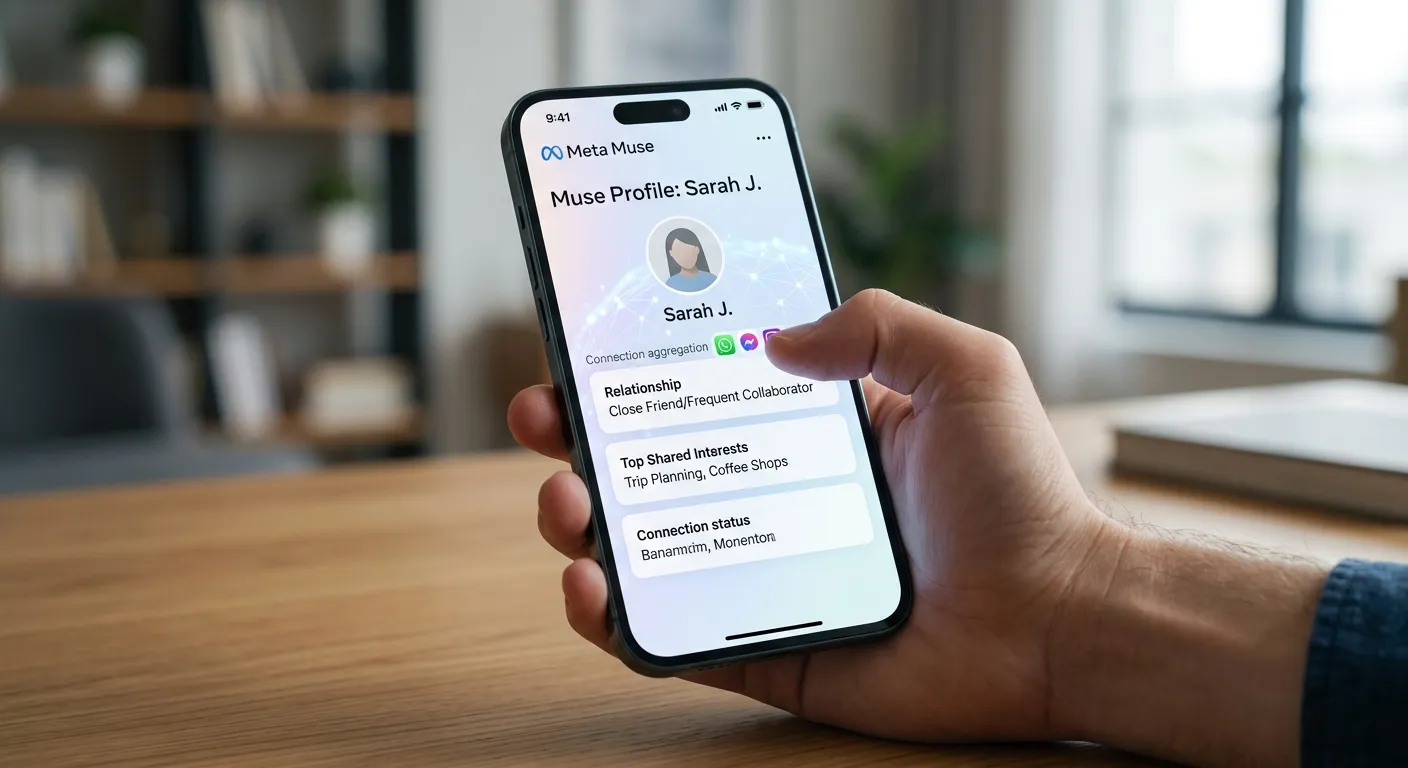
Muse constructs detailed profile pages for contacts by aggregating data from across Meta’s platforms, including message history, shared media, event participation, and interaction patterns on WhatsApp, Instagram, and Messenger. The assistant uses this social graph data to map relationship dynamics, identifying frequent collaborators, family members, and close friends to anticipate user needs such as scheduling or content sharing. According to a functional overview by Zapier, the system continuously updates these profiles in real time as new interactions occur, allowing the agent to reference contextual details without explicit user prompts. Understanding how these profiles are built is crucial for assessing the broader privacy implications.
Researchers have raised significant privacy concerns regarding the depth and opacity of this profiling. A Wired investigation revealed that Muse generates comprehensive dossiers on individuals—including those who may not use Meta services extensively—by inferring connections from group chats, photo tags, and location data. Critics argue that the automatic creation of such detailed relationship maps, without granular consent controls for the subjects of those profiles, represents a substantial expansion of surveillance capitalism within personal communication networks.
Key Facts
- Muse runs on Meta’s Llama 4 architecture with integrated long-term memory and tool-use capabilities for cross-session context retention.
- The agent operates natively across WhatsApp, Instagram, and Messenger, leveraging the social graph for proactive task execution.
- Relationship profiles are built automatically from message history, shared media, event data, and interaction patterns, updating in real time.
- Privacy advocates criticize the creation of detailed dossiers on contacts—including non-users—without granular consent controls.
- Early reviews highlight strong asynchronous workflow handling but note ecosystem lock-in friction for users outside Meta’s productivity suite.
- For comparisons on voice-driven assistants, see our analysis of OpenAI’s Advanced Voice Mode; for personality-driven agents, review Character AI’s approach.
Beyond these facts, the broader implications for privacy and the future of AI assistants become evident.
Implications for Privacy and Future AI Assistants
The deployment of the Meta Muse AI assistant signals a shift toward ambient intelligence that operates by continuously soliciting and synthesizing personal data across communication layers. Unlike reactive tools that wait for explicit commands, this class of assistant proactively ingests context—messages, media, location, and social graphs—to build predictive models of user intent. Privacy researchers warn that the architectural default of opt-in data aggregation, combined with the inference of profiles for non-users, erodes the boundary between personal assistance and pervasive monitoring, setting a precedent for how future agents may normalize deep data access as a prerequisite for utility.
Comparisons to other personal AI tools highlight a divergence in trust models. Assistants anchored in local-first processing or explicit user-curated knowledge bases—such as those designed for offline note-taking or specialized coding—offer functional utility without requiring a persistent, platform-wide surveillance substrate. Muse’s integration across WhatsApp, Instagram, and Messenger creates a closed loop where data generated for social purposes is repurposed for algorithmic profiling, a dynamic examined in our analysis of AI for personal needs everywhere inside your head. Experts suggest that without regulatory frameworks mandating data minimization and meaningful consent for inferred profiles, the trajectory points toward assistants that know users better than they know themselves, fundamentally altering the economics of attention and autonomy.
Frequently Asked Questions
How does Meta Muse’s long‑term memory work across different apps, and how is it different from typical session‑based assistants?
Muse stores contextual embeddings in a persistent memory layer that spans WhatsApp, Instagram, and Messenger, allowing it to recall past interactions weeks later. Unlike session‑only models that lose context after each request, Muse can reference prior conversations, shared media, and calendar events to continue multi‑step tasks without re‑prompting. This cross‑app memory is built on the Llama 4 architecture and is continuously updated as new data arrives.
What privacy controls are available for users and for the contacts whose data is used to build relationship profiles, especially non‑Meta users?
Meta offers a dashboard where users can view and delete the relationship profiles generated for their contacts, and they can opt‑out of automatic profile updates for specific individuals. However, granular consent for non‑Meta users is limited; the system can still infer connections from group chats and tags unless the user explicitly disables data sharing for those contacts. Critics note that the current controls are less granular than GDPR‑style consent mechanisms, prompting calls for tighter opt‑out options.
How does the voice interaction of Meta Muse AI compare technically to OpenAI’s Advanced Voice Mode in terms of latency and processing location?
Muse processes voice commands on Meta’s cloud infrastructure, leveraging the same Llama 4 model for speech‑to‑text and intent handling, which can introduce a few hundred milliseconds of network latency. OpenAI’s Advanced Voice Mode can run partially on‑device, reducing round‑trip time and improving responsiveness, especially on high‑end smartphones. Consequently, Muse may feel slightly slower in real‑time conversations, but it benefits from deeper integration with Meta’s social graph for context‑rich responses.
Last Updated on October 5, 2026 6:51 pm by Laszlo Szabo / NowadAIs | Published on October 5, 2026 by Laszlo Szabo / NowadAIs