Alibaba’s Qwen3.6-27B is now openly available for self-hosted deployment, but getting it running at full capacity demands hardware most small teams simply do not have on hand. The model packs 27 billion parameters across 64 layers, with a native context length of 262K tokens that can extend to 1 million — specs that translate directly into GPU memory pressure. It is the first open-weight release from the 3.6 family, and the gap between what it promises and what a typical developer workstation can deliver is worth examining before queuing the download.
What the Qwen3.6-27B Open Source Deployment Actually Requires

Running Qwen3.6-27B at the context lengths it advertises is not a weekend project on a single consumer GPU. The reference vLLM deployment example calls for a tensor-parallel-size of 8, serving on port 8000 with a max-model-len of 262,144 — in plain terms, eight GPUs working in parallel just to handle the base context window.
Supported frameworks include Hugging Face Transformers, vLLM, SGLang, and KTransformers, giving teams flexibility in how they serve the model. It also exposes an OpenAI-compatible API endpoint, which lowers integration cost for teams already running tooling built around that standard.
Alibaba positions the model as focused on practical construction rather than raw scale. As Mehul Gupta wrote in his technical walkthrough: “Instead of chasing size, the focus here is stability, better reasoning flow, and smoother coding experience. The result is a model that doesn’t just answer questions, it actually helps you build things.”
Real Capabilities, Real Limits
Qwen3.6-27B supports text, image, and video inputs, making it multimodal out of the box. Its claimed strengths center on developer workflows: coding and debugging, agent-based tasks, frontend and UI generation, refactoring large codebases, building full-stack applications, automating repetitive developer workflows, and handling long documents or entire repositories.
The model’s agentic behavior is described as genuinely iterative rather than purely generative. According to Gupta: “It can follow multi-step instructions, understand project structure, and make changes that actually make sense across files.” That description positions it less as an autocomplete engine and more as something that “doesn’t just generate output, it can plan, execute, and iterate.”
The reasoning mode is toggleable. Gupta notes that users can “keep it enabled for better results, or disable it for faster responses depending on your use case” — a practical concession that full reasoning carries a latency cost not every workflow can absorb.
Where the model falls short is on classic academic benchmarks. By the source author’s own account, Qwen3.6-27B is not always at the top on reasoning tests like GPQA and MMLU. It fares better on practical evaluations: according to Gupta, “it does well on real-world style evaluations like NL2Repo and QwenWebBench. These benchmarks test whether a model can actually build things, understand UI logic, and handle multi-step workflows.” The gap between leaderboard scores and practical output quality is the core argument Alibaba is making — though it remains a company claim, not an independently verified finding.
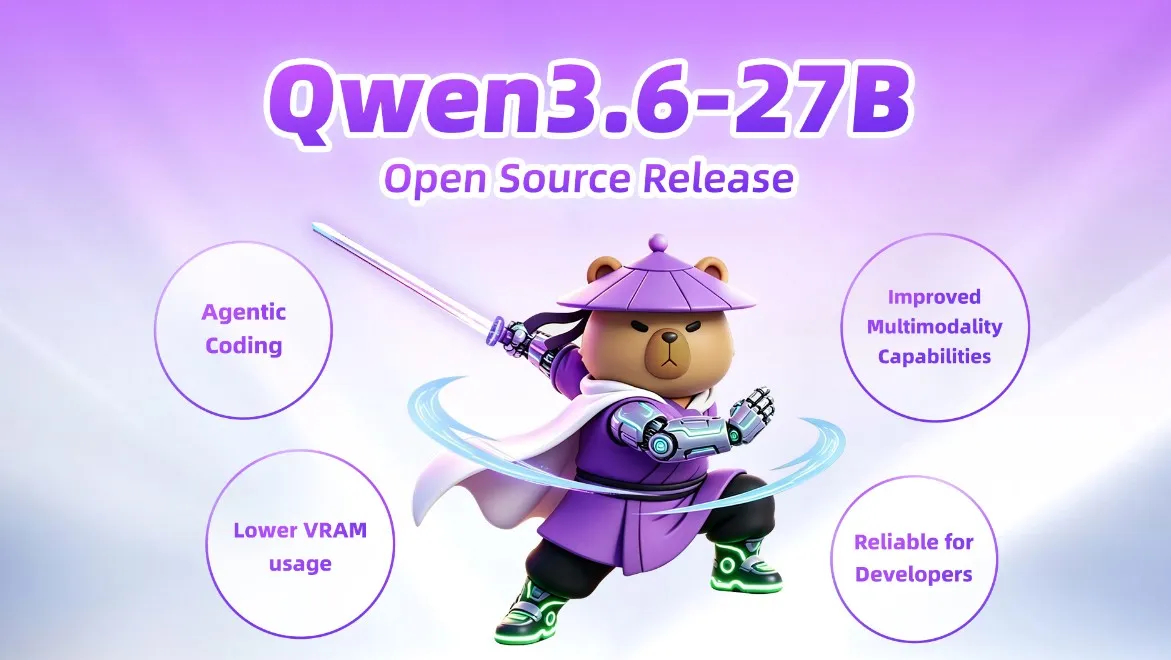
The release image chosen to represent the model — a cartoon bear in a purple ninja outfit wielding a glowing sword — signals a deliberately playful brand identity. It is an unusual visual choice for enterprise adoption materials, but it tracks with how Alibaba has marketed the Qwen line to the developer community.
NVIDIA’s Endorsement and an Open-Source Security Warning
The hardware picture shifted meaningfully when NVIDIA identified Qwen 3.6 models as well-suited for its Hermes agent framework. According to the NVIDIA Blog, the Qwen 3.6 27B and 35B parameter models are outperforming their previous-generation 120B and 400B parameter counterparts and are running on NVIDIA RTX and DGX Spark hardware for accelerated agentic AI workloads. That endorsement confirms at the infrastructure level that the efficiency gains Alibaba claims have at least partial third-party backing.
The open-source deployment story does not exist in a vacuum, however. A sprawling supply-chain attack dubbed Mini Shai-Hulud has recently compromised hundreds of open-source packages, including high-profile projects like TanStack and MistralAI, according to Let’s Data Science. For teams evaluating whether to self-host an open-weight model like Qwen3.6-27B, the incident is a concrete reminder that the open-source supply chain carries systemic risk that managed API services do not expose to the same degree.
Meanwhile, the enterprise AI conversation is drifting away from model benchmarks entirely. As VentureBeat reports, the competitive frontier is shifting toward who controls the agent orchestration layer — where agents plan, call tools, access data, and run workflows. A capable open-weight model is a necessary but not sufficient condition for winning that layer; the infrastructure and control plane around it matter just as much.
What to Watch Next
Two questions the release leaves open are worth tracking. The first is how Alibaba intends to update the 3.6 family — whether Qwen3.6-27B remains a stable production target or becomes a stepping stone toward a larger model in the same lineage. The second is whether use cases beyond developer tooling emerge at scale.
The multimodal capabilities and million-token context window suggest potential applications in document-heavy industries, legal tech, and long-horizon research workflows, but none of those have been publicly demonstrated yet. The model’s ability to handle long documents and entire repositories hints at use cases that reach well beyond coding assistants.
For teams with the GPU infrastructure to run it, Qwen3.6-27B represents a credible self-hosted alternative to managed coding assistants. For everyone else, the deployment requirements and the broader open-source security environment mean the calculus is less straightforward than the free-access headline suggests.
FAQ – Frequently Asked Questions
What are the estimated costs of running Qwen3.6-27B on cloud infrastructure?
Running Qwen3.6-27B on cloud infrastructure can cost between $10 to $50 per hour depending on the cloud provider and the specific GPU configuration used. For example, using 8 NVIDIA A100 GPUs on AWS can cost around $30 per hour. Costs can be optimized by using spot instances or reserved capacity.
How does Qwen3.6-27B compare to other multimodal models in terms of performance?
Qwen3.6-27B has been shown to outperform some larger models on practical tasks, but a comprehensive comparison to other state-of-the-art multimodal models like Gemini or Claude is not yet available. Early benchmarks suggest competitive performance, but more detailed evaluations are needed to fully assess its relative strengths.
Are there any pre-built Docker containers available for deploying Qwen3.6-27B?
Yes, several community contributors have published Docker containers that simplify the deployment of Qwen3.6-27B. These containers often include optimized configurations for specific hardware setups and can be found on Docker Hub or other container registries.
Last Updated on October 10, 2026 12:45 pm by Laszlo Szabo / NowadAIs | Published on May 18, 2026 by Laszlo Szabo / NowadAIs