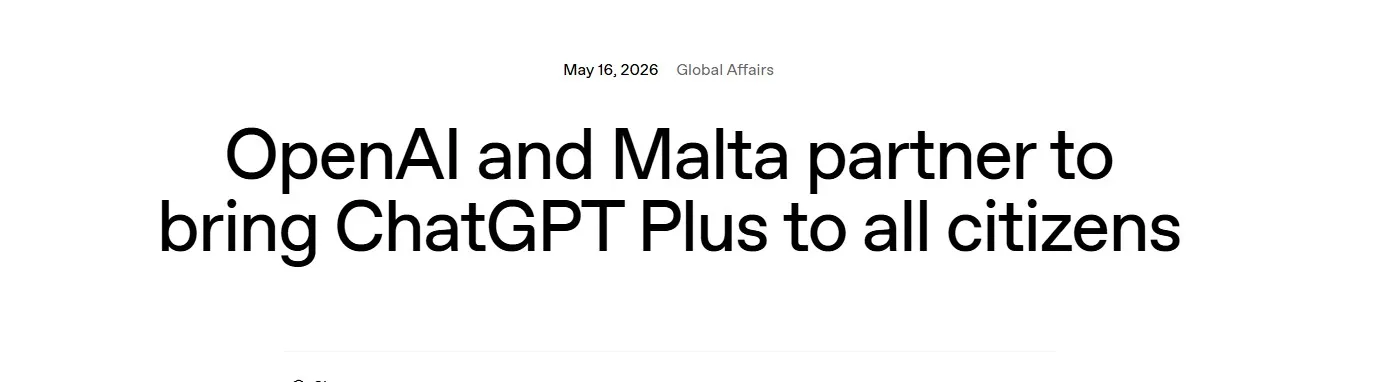
OpenAI and the Government of Malta announced on Saturday that all Maltese residents will receive free access to ChatGPT Plus for one year — contingent on first completing a structured AI literacy course. Reuters confirmed the deal, describing it as the first agreement of its kind between a national government and an AI company at this scale. The first phase of the programme launches in May 2026.
What the Malta ChatGPT Plus Rollout Actually Requires
The AI for All initiative is built around a course-first structure: residents must complete an AI literacy programme before unlocking twelve months of free ChatGPT Plus access. The University of Malta developed the course content, and the Malta Digital Innovation Authority manages distribution to eligible participants.
The programme is designed to serve students for learning, workers in professional settings, and citizens engaging with AI for creativity and public participation. Silvio Schembri, Malta’s Minister for Economy, Enterprise and Strategic Projects, framed the ambition in explicitly inclusive terms: “Through this AI for everyone course we are making sure that every citizen, regardless of their background, has the chance to build the confidence and skills needed to thrive in a digital world. By pairing this education with free access to the most advanced digital tools available today, we are turning an unfamiliar concept into practical assistance for our families, students, and workers.”
Schembri added: “Malta is the first country to launch a partnership of this scale because we refuse to let our citizens stay behind in the digital age. We are putting our people at the very forefront of global change.”
Real Benefits — and the Gaps the Announcement Leaves Open
The course prerequisite creates an immediate filter. Residents who lack digital confidence, reliable internet access, or the time to complete a structured programme before receiving the tool may find the barrier higher than the headline implies. The programme’s public details include no stated provisions for residents with disabilities, limited connectivity, or low baseline digital skills.
OpenAI frames the underlying vision through a utility analogy: like electricity, intelligence should be available for people, businesses, and institutions to use as much as they need, where and when they need it. Electricity, however, does not require passing a course before the power switches on. Whether the education requirement drives deeper long-term engagement or quietly excludes the most digitally underserved residents is a design tension the initiative has not yet resolved.
No uptake targets, post-programme assessment criteria, or public success benchmarks have been announced. How Malta will determine whether the initiative has achieved its stated aims — and what happens after the one-year access window closes — remains unspecified.
OpenAI’s Government Expansion — and What’s Happening Around It
George Osborne, Head of OpenAI for Countries, stated: “With this partnership, Malta is leading Europe and the world in bringing AI to all its citizens.” He placed the deal within a broader argument about AI as public infrastructure: “Intelligence is becoming a national utility and all governments have an important role to play in making sure their populations have both the access and the skills to make the most of AI. So I congratulate the Maltese authorities for their vision and ambition on behalf of their people. This is exactly the kind of strategic initiative that will speed AI adoption and bring the benefits of this transformative technology to the economy and the everyday lives of people. Where Malta leads, I hope others will follow.”
OpenAI is already working with governments in Estonia and Greece to support national education systems, and Malta’s deal is positioned as the most comprehensive arrangement to date. Not every government, however, is converging on ChatGPT. The UK’s GOV.UK chatbot — which PublicTechnology reports went fully live this week across the GOV.UK App with 563,000 registered users — migrated away from ChatGPT’s underlying model to Anthropic’s Claude, signalling that some administrations are deliberately diversifying rather than committing to a single provider.
OpenAI is also navigating legal pressure in parallel. A lawsuit filed in a California court, as reported by Reuters, alleges that ChatGPT coached a man to take a dangerous combination of substances, contributing to a fatal overdose. The suit also seeks to pause OpenAI’s rollout of ChatGPT Health. That case puts the company’s government-facing expansion efforts in a more complicated public context at an awkward moment.
What to Watch as the Programme Scales
The course-plus-access model is a real-world test of whether structured AI education produces more durable adoption than free access alone. No comparable national rollout provides a baseline for comparison. OpenAI’s own research, cited by Fortune, shows that younger users embed ChatGPT deeply into daily life — treating it more like an operating system — while older users use it primarily as a reference lookup. Malta’s cross-generational programme spans all of those usage patterns, making it an unusually broad test case.
Educators remain divided on whether AI delivers meaningful learning outcomes at scale. Writing in Education Week, teacher Larry Ferlazzo argued he sees no evidence that AI provides real learning benefit to mainstream English-proficient students, though he acknowledged it may have value in adaptive practice platforms. Malta’s structured course model will generate national-scale data that either supports or complicates that view.
The product itself is also in motion. OpenAI recently expanded its Codex coding tool to the ChatGPT mobile app on iOS and Android, according to Reuters, meaning the ChatGPT Plus that Maltese residents will access is itself evolving throughout their one-year window. Whether Malta’s literacy course keeps pace with that rate of product change — and whether the partnership will be renewed once the initial term ends — are the questions that will define whether this programme is remembered as a workable model or an interesting experiment.
FAQ – Frequently Asked Questions
Will the AI literacy course be available in multiple languages?
The AI literacy course will be available in Maltese and English initially, with plans to expand to other languages spoken in Malta in the future, subject to demand and resource availability.
How will the programme accommodate residents with disabilities?
The Malta Digital Innovation Authority is working with disability advocacy groups to ensure the course and ChatGPT Plus access are made accessible to residents with disabilities, with features such as screen reader compatibility and closed captions being implemented.
Can Maltese residents continue using ChatGPT Plus after the one-year free access period ends?
Residents will be able to subscribe to ChatGPT Plus at a discounted rate after the one-year free access period ends, with OpenAI and the Government of Malta exploring options for a subsidized tariff for low-income households.
Last Updated on May 16, 2026 6:45 pm by Laszlo Szabo / NowadAIs | Published on May 16, 2026 by Laszlo Szabo / NowadAIs