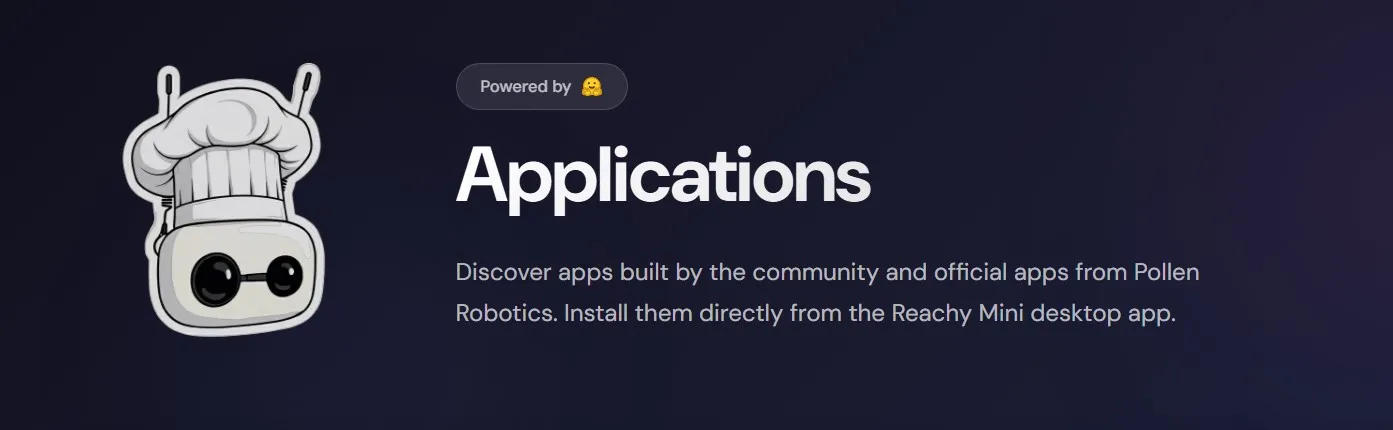
Hugging Face has launched the Reachy Mini App Store, a free marketplace hosting more than 200 community-built applications for its $299 open-source desktop robot. The store opened this week with contributions from 150 different creators and requires no coding knowledge to use or build for. Behind the headline numbers, however, the platform carries structural constraints that will matter to anyone planning to build on it seriously.
What the Hugging Face Reachy Mini App Store Actually Launched
The 10-year-old New York City startup Hugging Face built the Reachy Mini App Store on top of Spaces, its hosted application infrastructure introduced in 2021. The robot itself, the Reachy Mini, debuted in July 2025 as the direct result of Hugging Face’s acquisition of Pollen Robotics.
Sales figures released alongside the store launch show 10,000 Reachy Mini units sold to date, with 3,000 of those moving in just the past two weeks. Hugging Face expects to ship another 1,000 units within the next 30 days.
Apps are created through an agentic toolkit called ML Intern. Users describe desired robot behavior in plain English, and the agent writes, tests, and ships code directly to the device. CEO and co-founder Clément Delangue said he put together a functional receptionist application in two hours. “Anyone can build the apps,” he said.
Concrete Benefits—and Where the Platform Falls Short
The app store supports a range of AI models, including GPT-5.5, Claude Opus 4.6, Kimmy 2.6, Mini Max GM5, Deep Sig V4 Pro, OpenAI Realtime, and Gemini Live. Delangue said, “My intuition is that more and more [AI] model builders will release on Reachy Mini as a way to test the robotics ability of new models.”
“For the moment, all the apps are free,” Delangue confirmed. He added: “It’s flexible, it’s built on [Hugging Face] Spaces, so at some point maybe people are going to make them paid”—but no monetization timeline has been set, and creators currently earn nothing from their contributions.
The Reachy Mini Lite’s hardware profile adds another constraint. At $299, it connects to an external computer via USB and offloads all processing there. Users looking for a self-contained robot will need a higher-tier model or a future hardware revision.
Delangue acknowledged that robotics has historically excluded non-engineers. “Historically, it’s been extremely hard,” he said. “But we’ve worked really hard on the topic with a mix of open sourcing everything we do, working on the right abstractions for robotics, and making it easier for agents to understand and use it.” He has previously argued that closed-source hardware and software are “almost impossible” to build for at scale—a direct argument for why Hugging Face went open.
The 150 contributors who filled the launch catalog include users well outside the developer world. Joel Cohen, a 78-year-old retired marketing executive, built a “VP of Future Thinking” facilitator designed to run Zoom-based CEO peer group sessions. “I built this by describing what I needed in plain English,” Cohen said. His participation is exactly the use case Hugging Face wants to showcase—robots becoming as accessible to ordinary people as PCs and smartphones once did.
Industry Pricing, Open-Source Risk, and Broader Context
Price positioning is central to everything Hugging Face is doing here. Boston Dynamics’ Spot robot dog retails for around $70,000, while Chinese competitors have entered the consumer robotics space with robot dogs starting at $1,900. A $299 entry point sits in a category neither of those players currently occupies.
More than 17,000 different repositories dedicated to robotics exist on GitHub today, and Hugging Face’s own LeRobot project—started in 2024—forms the core software foundation for Reachy Mini development. The broader GitHub ecosystem, including GitHub Copilot, GitHub Spark, GitHub Models, and the MCP Registry, extends the tooling available to developers building on the platform.
Open-source distribution at scale carries documented risks that Hugging Face has not fully addressed. A separate recent incident on the company’s main model hub saw a malicious repository impersonating an OpenAI release accumulate 244,000 downloads before it was removed. That incident raises direct questions about whether the Reachy Mini App Store has the vetting mechanisms to prevent broken or harmful apps from reaching robot owners at scale.
Open Questions and What to Watch Next
Monetization is the most immediate unresolved issue. Once paid apps become possible on the Spaces infrastructure, Hugging Face will face decisions about revenue splits, curation standards, and how to maintain quality without closing off the community access that attracted 150 creators to contribute before launch.
The LeRobot project’s trajectory also matters. Launched in 2024 as an open-source effort to simplify AI-powered robotics, it has not yet clarified whether it is evolving toward a formalized commercial SDK or staying a research-grade toolkit. That distinction will shape the complexity ceiling of apps that can realistically be built for the store.
Longer term, the store’s value as an AI benchmarking environment may prove as significant as its consumer ambitions. With GPT-5.5, Claude Opus 4.6, and Gemini Live already integrated, physical robot behavior is becoming a new testing surface for frontier models. Whether the Reachy Mini App Store stays a hobbyist marketplace or becomes a standard evaluation environment for AI labs is the question worth tracking over the next twelve months.
FAQ – Frequently Asked Questions
Will there be any revenue-sharing model introduced for creators on the Reachy Mini App Store?
Hugging Face is exploring various revenue-sharing models, including a potential subscription-based service for premium apps and a royalty model for top-grossing applications. The company is currently gathering data on user engagement and app performance to inform their decision. A formal announcement is expected within the next quarter.
Can I use the Reachy Mini with my existing computer hardware?
The Reachy Mini is compatible with most modern computers running Windows 10 or later, macOS High Sierra or later, or Linux distributions with kernel 5.0 or higher. However, for optimal performance, Hugging Face recommends using a computer with at least 8 GB of RAM and a dedicated graphics card. A full list of system requirements is available on the Reachy Mini support website.
Are there plans to expand the Reachy Mini App Store to support other Hugging Face robots or third-party robotics platforms?
Hugging Face is actively working on integrating the Reachy Mini App Store with their other robotics projects, including the upcoming Reachy Max robot. Additionally, the company is in talks with several third-party robotics manufacturers to explore potential partnerships and expand the app store’s compatibility with other platforms. An update on these developments is expected at the next Hugging Face Developer Conference.
Last Updated on May 12, 2026 9:08 am by Laszlo Szabo / NowadAIs | Published on May 12, 2026 by Laszlo Szabo / NowadAIs