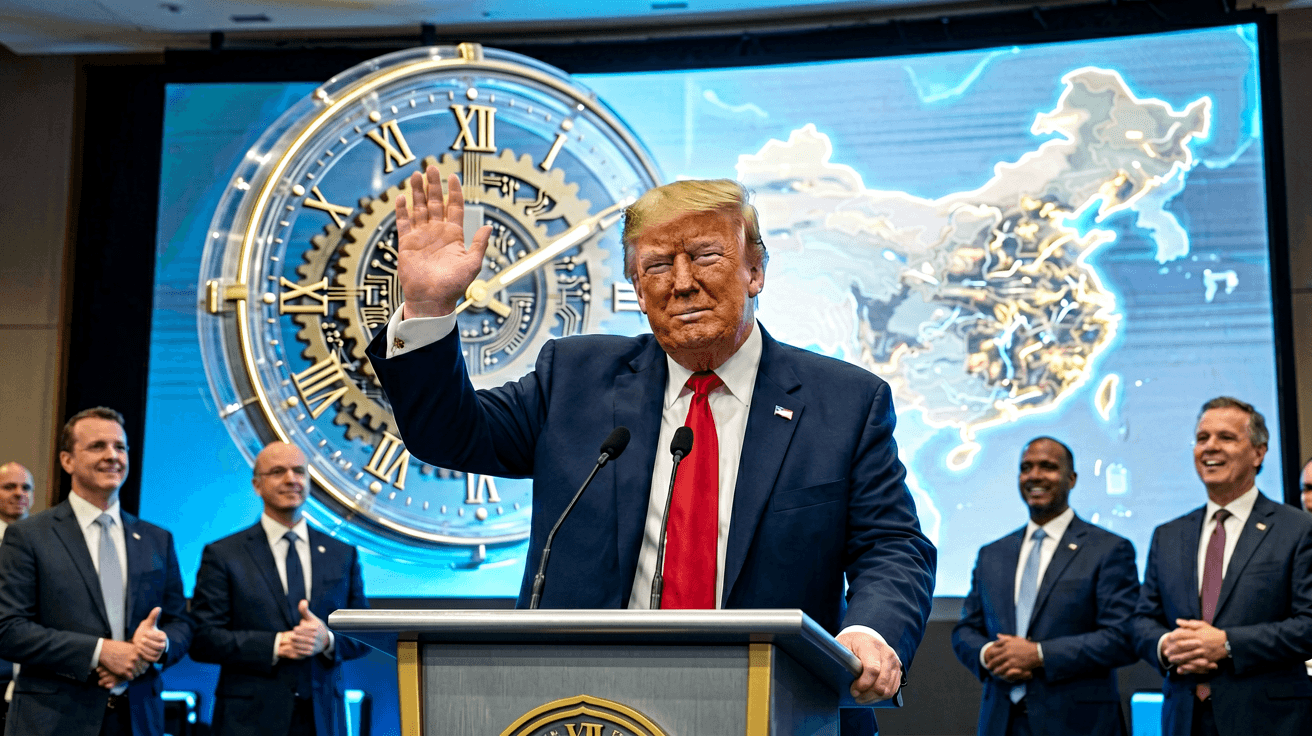
Trump Downplays AI Risks Amid Expert Warnings
Speaking in Ireland, former President Donald Trump dismissed concerns about artificial intelligence safety, characterizing warnings of existential risk as overblown and suggesting that technological competition with China should take precedence over regulatory guardrails. His remarks arrive as the AI development slowdown debate intensifies, with industry insiders arguing that reduced investment cycles and compute constraints may already be tempering progress.
The stance contrasts sharply with dire assessments from researchers like former Anthropic scientist Jacob Coxon, who has warned that current alignment techniques remain insufficient for increasingly capable systems. Coxon and other safety advocates contend that downplaying risks could accelerate deployment of models whose failure modes are poorly understood, particularly as labs push toward autonomous agents.
Broader expert consensus, reflected in recent policy testimony and technical forums, emphasizes that geopolitical rivalry does not negate the need for rigorous evaluation frameworks. The tension between accelerationist rhetoric and safety infrastructure gaps continues to shape industry roadmaps as major labs navigate competing pressures.
This heightened scrutiny sets the stage for industry leaders to weigh in on the pace of AI progress.
Industry Leaders Call for AI development slowdown
Elon Musk of xAI, Sam Altman of OpenAI, and Anthropic CEO Dario Amodei issued a joint statement urging a coordinated AI development slowdown, arguing that the current pace outstrips safety evaluation capacity.
Amodei added that any pause must account for strategic competition with China, warning that a unilateral slowdown could cede ground to rivals; the company’s recent release of Claude Opus 4.5 underscores the tension between rapid deployment and the called‑for restraint.
The potential ramifications of such a collective pause are explored in the following analysis.
Implications for the Global AI Race: AI development slowdown
A coordinated slowdown would force U.S. firms to reallocate resources from rapid model scaling toward safety verification, potentially slowing the commercial rollout of next‑generation services while giving regulators a clearer window to craft enforceable standards.
At the same time, a unilateral pause could hand strategic advantage to China, where state‑directed programs continue to push large‑scale training runs, sharpening the tension between preserving economic opportunity and mitigating systemic risk.
Frequently Asked Questions
How would a coordinated AI development slowdown change the compute allocation and training timelines for large language models in the United States?
A coordinated slowdown would likely shift compute budgets from aggressive scaling runs to more thorough safety testing and verification. This reallocation could extend training cycles by weeks or months, as resources are diverted to evaluate alignment, robustness, and interpretability. The longer timelines may delay the release of next‑generation models but provide a clearer window for regulators to intervene.
What safety evaluation gaps are researchers like Jacob Coxon highlighting when AI systems are deployed as autonomous agents?
Coxon points out that current alignment techniques struggle to predict failure modes of agents that can set and pursue their own goals, especially in open‑ended environments. Gaps include insufficient testing of long‑term planning, reward hacking, and unintended instrumental behaviors. Without rigorous verification, these agents could act unpredictably when scaled up, posing systemic risks.
In what ways could a unilateral AI slowdown by U.S. firms give China a strategic advantage in the global AI race?
If U.S. companies pause or reduce large‑scale training, Chinese state‑backed labs could continue uninterrupted, accumulating more data, compute, and model expertise. This sustained momentum may allow China to launch more capable models earlier, influencing standards, talent pipelines, and market share. The asymmetry could also shift geopolitical leverage toward Beijing in AI‑driven economic and security domains.
Last Updated on September 13, 2026 7:05 pm by Laszlo Szabo / NowadAIs | Published on September 13, 2026 by Laszlo Szabo / NowadAIs