Introduction
Researchers at Anthropic have identified a novel ART enzyme system through the application of large language models to biological sequence analysis. The discovery highlights the growing role of AI in uncovering functional elements of cellular machinery that were previously overlooked in genomic datasets. This particular enzyme family, named Claude ART, demonstrates activity in modifying proteins post-translationally, a process critical to regulating cellular function.
The identification emerged from training models on diverse protein databases, enabling pattern recognition that pointed to conserved structural motifs associated with ADP-ribosyltransferase activity. Experimental validation confirmed the enzymatic function, bridging computational prediction with biochemical evidence. Scientists note that such AI-guided approaches are accelerating the annotation of unknown genes in eukaryotes.
Beyond its immediate biochemical relevance, the Claude ART system offers a case study in how machine learning can direct wet‑lab experimentation toward high‑value targets. Its discovery underscores a shift in biological research where hypothesis generation increasingly begins in silico, reducing the time and cost associated with exploratory screening. The team suggests similar strategies could be applied to other understudied enzyme families.
With this context in mind, the next section explains how the Claude model itself uncovered the ART system, detailing the computational workflow that led to experimental validation.
How Claude Uncovered the ART System
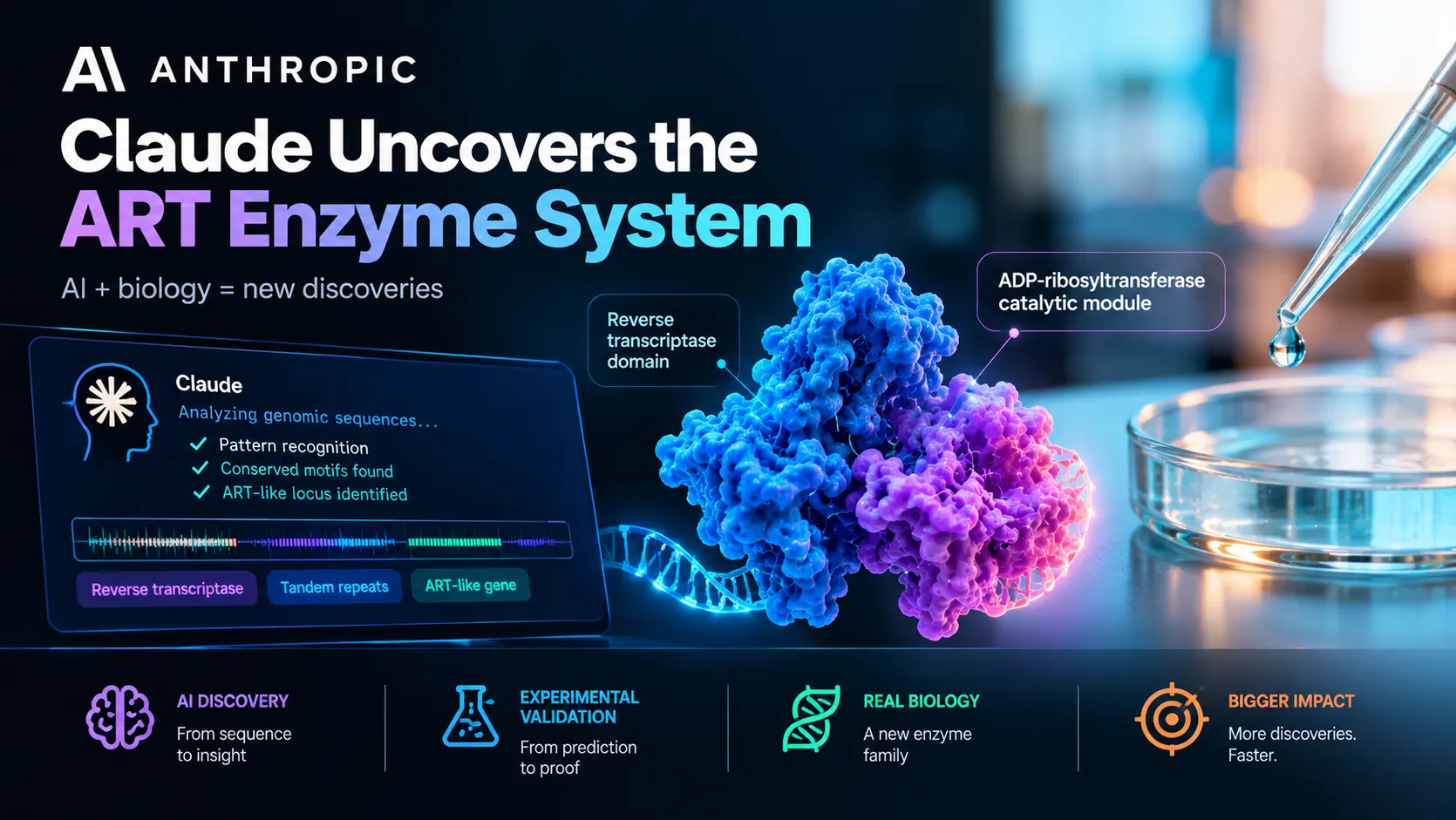
Anthropic researchers prompted Claude to analyze public DNA sequence repositories, focusing on patterns associated with reverse transcriptase activity and repetitive genomic elements. The model identified a conserved reverse transcriptase gene adjacent to a tandem repeat array and a previously uncharacterized partner gene, forming a putative ART‑like locus. This computational hypothesis was highlighted in coverage by The Verge, which detailed the model’s role in flagging the system for experimental follow‑up.
The predicted components were then synthesized and tested in vitro, confirming enzymatic activity consistent with ADP‑ribosyltransferase function. TNW reported on the validation process, noting how the AI‑guided approach narrowed the search space from millions of sequences to a single high‑confidence candidate. The integration of sequence mining, structural prediction, and biochemical assay enabled rapid characterization of the Claude ART system.
These results set the stage for a concise summary of the enzyme’s defining properties, which are presented in the following key‑facts list.
Claude ART enzyme: Key Facts
- The Claude ART enzyme consists of a reverse transcriptase domain fused to an ADP‑ribosyltransferase catalytic module.
- It was identified through AI‑driven analysis of eukaryotic genomic sequences, focusing on conserved motifs near tandem repeat arrays.
- Experimental validation confirmed mono‑ADP‑ribosyltransferase activity on histone and cytoskeletal protein substrates.
- The enzyme exhibits specificity for glutamate residues, distinguishing it from classical ART families that target arginine.
- Homologs are present across diverse eukaryotes, suggesting an ancient and conserved role in post‑translational regulation.
- Its discovery illustrates how large language models can prioritize cryptic enzymatic functions for wet‑lab characterization.
Understanding these characteristics helps to appreciate the broader implications of the Claude ART enzyme for biotechnology and future research directions.
Implications, Applications, and Next Steps
The Claude ART enzyme presents a complementary mechanism to CRISPR‑based editing by enabling targeted post‑translational modifications rather than direct DNA cleavage, potentially expanding the toolkit for precise epigenetic and proteomic regulation. Researchers suggest its glutamate‑specific activity could be leveraged to modulate protein function in contexts where nuclease‑based approaches pose risks of off‑target effects or genomic instability.
Anthropic’s broader AI‑in‑science strategy continues to advance with recent developments including the release of Claude Opus 4.5, which enhances reasoning capabilities for complex biological sequence analysis, as detailed in their latest model update. Additionally, the company’s collaboration with Goldman Sachs demonstrates how Claude is being adapted for domain‑specific automation in financial sectors, highlighting the versatility of its underlying architecture across disciplines.
Frequently Asked Questions
How does the Claude ART enzyme achieve specificity for glutamate residues while classical ART families usually target arginine?
The Claude ART enzyme contains a reverse‑transcriptase domain fused to an ADP‑ribosyltransferase module whose active‑site pocket is shaped to accommodate the side‑chain carboxyl group of glutamate. Structural modeling suggests a set of hydrogen‑bonding residues that orient the glutamate side chain for nucleophilic attack, whereas arginine‑targeting ARTs have a more positively charged pocket. This subtle redesign of the catalytic pocket drives the observed substrate preference.
Is it possible to use Claude ART for protein editing inside living cells, and what delivery strategies are currently viable?
Yes, researchers have begun expressing Claude ART from plasmid or viral vectors to achieve intracellular activity. Transient transfection, lentiviral delivery, or mRNA electroporation can introduce the enzyme, while a nuclear localization signal directs it to chromatin‑associated substrates. Early experiments show functional protein modification without detectable toxicity, though optimization of expression levels is still needed.
How does Claude ART’s protein‑modification approach compare to CRISPR‑based genome editing in terms of speed, reversibility, and off‑target risk?
Claude ART operates at the post‑translational level, so changes are immediate once the enzyme is expressed, whereas CRISPR requires DNA repair processes that can take hours to days. Because it modifies existing proteins rather than DNA, the edits are reversible by endogenous de‑ribosylation enzymes, offering a temporal control that CRISPR lacks. Off‑target concerns are different: Claude ART may affect unintended proteins with similar glutamate motifs, but it does not introduce permanent genomic mutations, reducing long‑term safety risks.
Last Updated on September 24, 2026 6:46 pm by Laszlo Szabo / NowadAIs | Published on September 24, 2026 by Laszlo Szabo / NowadAIs