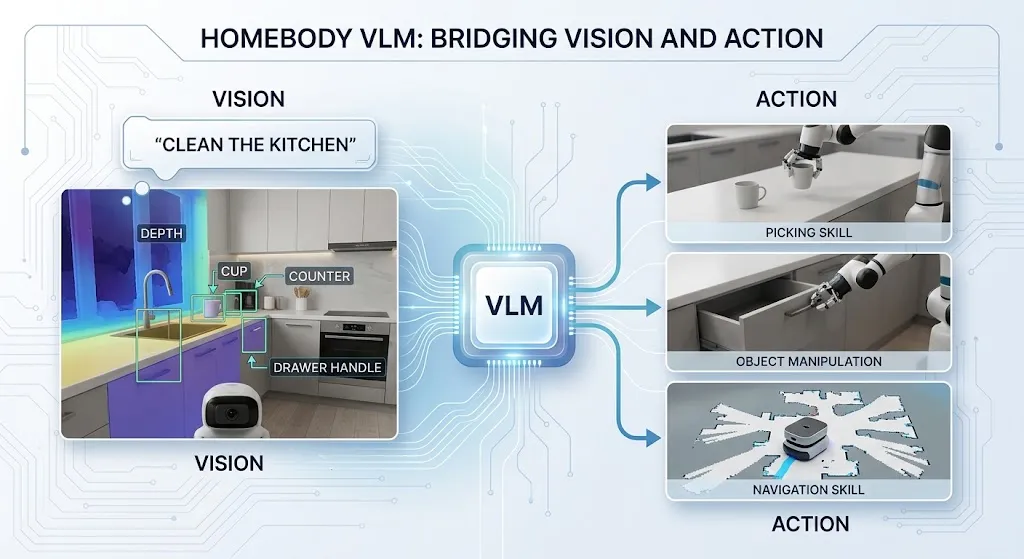
HomeBody VLM: Bridging Vision and Action
The HomeBody system introduces a modular architecture where a vision-language model serves as a semantic reasoning layer atop a library of reusable robotic skills. Rather than training an end-to-end policy for every new environment, the VLM interprets high-level instructions and visual observations to select and parameterize existing skills—such as navigation, grasping, or object manipulation—enabling zero-shot generalization in previously unseen homes.
This plug‑in approach treats the VLM as a replaceable cognitive module, decoupling perception and reasoning from low-level control. Researchers recently demonstrated a similar paradigm by connecting a powerful VLM directly to a mobile manipulator, allowing it to clean up an unfamiliar kitchen without task-specific fine-tuning. HomeBody extends this concept by formalizing the skill interface, ensuring the VLM’s outputs map reliably to verified, safe motion primitives. This modular foundation paves the way for the concrete translation pipeline described next.
How HomeBody Translates Vision into Motion
The pipeline begins when the VLM receives a high-level instruction and the current RGB-D observation. It first selects an appropriate skill from the library—navigation, picking, placing, or drawer opening—then emits a structured tool call that specifies the spatial targets required by that skill. For navigation, the target is a 2D waypoint on the occupancy map; for picking and placing, the VLM outputs a 3D object centroid and an approach vector; for drawer articulation, it provides the handle pose and pull direction.
Depth for these 3D targets comes from Fast‑FoundationStereo running on the Intel RealSense D435i stereo pair, producing dense metric depth at real-time rates. The perception stack fuses this depth with the RGB segmentation masks to compute accurate centroids and surface normals. An analytic grasp planner then consumes the target geometry, evaluating antipodal grasp candidates on the local point cloud and selecting a collision‑free pose that satisfies the approach constraints supplied by the VLM.
Once the skill and its parameters are fixed, the low‑level controller executes the motion primitive—whether a whole‑body navigation trajectory, a Cartesian arm motion for grasping, or a hybrid force‑position profile for drawer pulling—while the VLM monitors progress and issues the next tool call. This separation keeps the reasoning loop lightweight and the execution deterministic, allowing the system to chain multiple skills reliably in unfamiliar homes. The key technical takeaways are summarized below.
Key Facts
- HomeBody VLM acts as a semantic reasoning layer that selects and parameterizes reusable robotic skills for zero-shot generalization in unseen homes.
- The system decouples high-level vision-language reasoning from low-level control, treating the VLM as a swappable cognitive module.
- Fast‑FoundationStereo processes stereo pairs from the Intel RealSense D435i to deliver dense metric depth at real-time rates for 3D target estimation.
- An analytic grasp planner evaluates antipodal candidates on local point clouds to produce collision-free poses constrained by VLM-specified approach vectors.
- Skills include navigation, picking, placing, and drawer articulation, each executed by deterministic motion primitives monitored by the VLM.
- This modular architecture mirrors recent research connecting VLMs directly to mobile manipulators for open-vocabulary task execution without task-specific fine-tuning.
These capabilities open up a range of practical implications and suggest promising avenues for future research.
Implications and Future Directions
The plug‑in VLM architecture demonstrated by HomeBody VLM suggests a practical path toward generalist mobile manipulators that can be upgraded cognitively without re‑engineering the motion stack. Because the vision‑language module only emits structured tool calls, researchers can swap in larger or domain‑specialized models as they become available, while the grasp planner and whole‑body controller remain stable. This separation also lowers the barrier for sim‑to‑real transfer: policies trained in simulation can be validated against the same analytic primitives before deployment.
Extending the skill library to include articulated‑object manipulation beyond drawers—such as doors, appliances, and deformable materials—will require richer spatial descriptors. Technologies that produce instant 3D mesh reconstructions from single views, like Tencent’s InstantMesh, could supply the detailed geometry needed for contact‑rich planning without waiting for multi‑view fusion. Coupling such fast mesh generation with the existing depth pipeline would give the VLM a more complete scene representation, enabling reasoning about occlusion, containment, and tool use in cluttered homes.
Frequently Asked Questions
How does HomeBody VLM handle depth estimation errors from Fast‑FoundationStereo when generating 3D targets?
The system fuses the dense metric depth from Fast‑FoundationStereo with RGB segmentation masks and applies a confidence filter to discard low‑certainty points. It also uses a local point‑cloud smoothing step before computing object centroids and surface normals, which mitigates noise. If the residual error exceeds a safety threshold, the VLM requests a re‑capture or falls back to a conservative grasp pose.
Can the modular VLM be swapped with a different vision‑language model without retraining the skill library, and what steps are required?
Yes, the architecture treats the VLM as a replaceable cognitive module; only the tool‑call interface needs to be matched. To swap models, developers must implement the same JSON schema for skill selection and parameter output, validate that the new model respects the required latency, and run integration tests on the skill wrappers. No re‑training of the underlying motion primitives or skill library is needed.
What are the computational requirements for running HomeBody VLM and Fast‑FoundationStereo in real‑time on a mobile manipulator?
A typical deployment uses an NVIDIA Jetson AGX Orin or equivalent GPU for the VLM inference, paired with a multi‑core ARM CPU for Fast‑FoundationStereo processing. The VLM inference runs at roughly 10–15 Hz, while Fast‑FoundationStereo delivers depth at 30 Hz, keeping the overall perception‑to‑action loop under 100 ms. Memory usage stays below 8 GB, allowing the stack to run on most modern edge compute platforms.
Last Updated on September 27, 2026 7:00 pm by Laszlo Szabo / NowadAIs | Published on September 27, 2026 by Laszlo Szabo / NowadAIs