Trump AI czar: New AI Force Announced
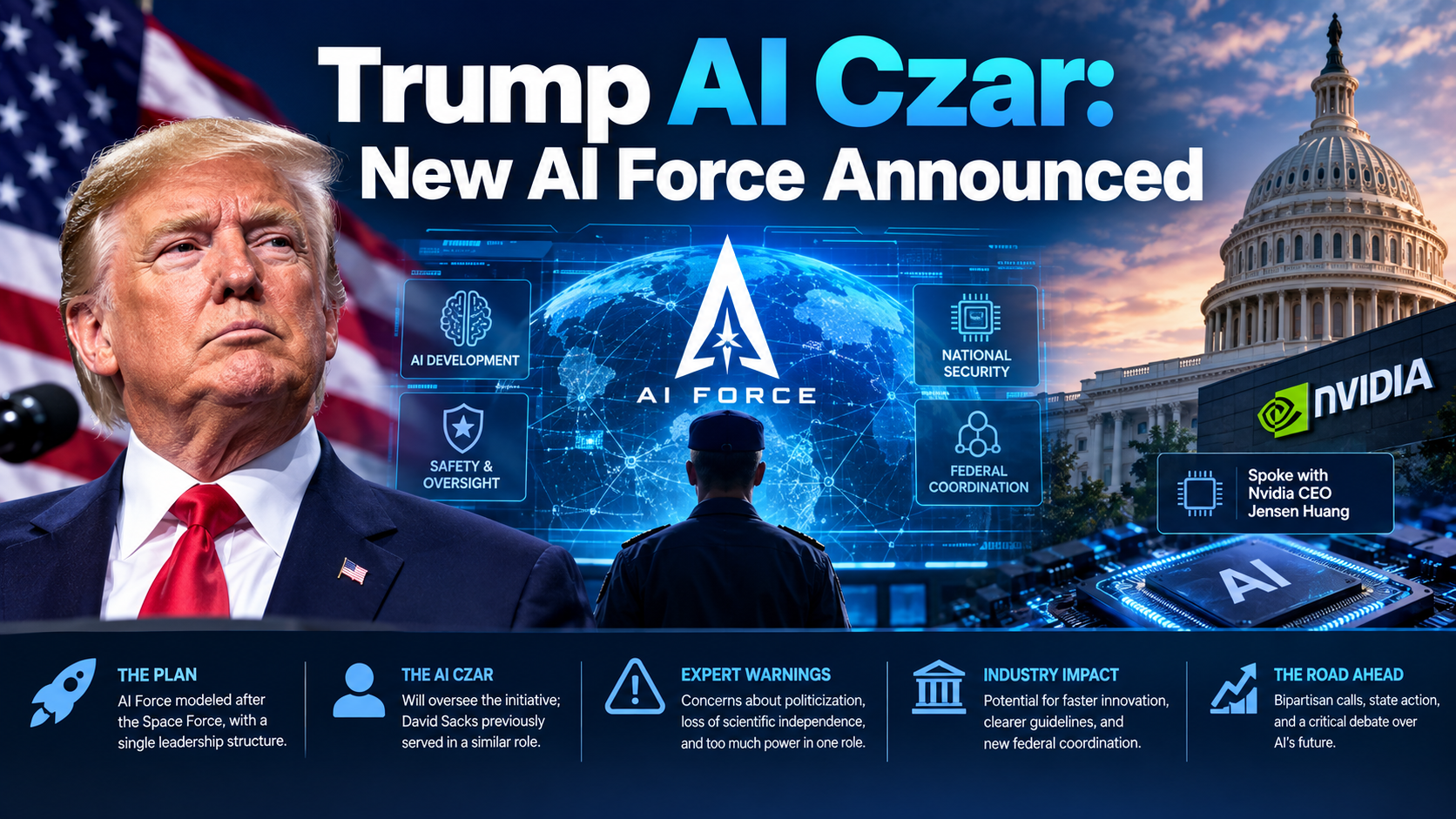
Former President Donald Trump announced on Truth Social that he will create an AI Force and appoint an AI czar, stating he spoke with Nvidia CEO Jensen Huang about the initiative.
According to Reuters, the proposed AI Force would mirror the structure of the Space Force, focusing on national AI development and safety oversight.
Axios reports that the initiative aims to centralize federal AI efforts under a single leadership role, drawing parallels to the military‑style organization of the Space Force.
These announcements set the stage for the specific details outlined below.
Key Facts
- Trump’s proposed AI Force would be modeled after the U.S. Space Force, aiming to centralize federal AI development and safety oversight under a single leadership structure.
- The AI czar role would oversee the new initiative, with David Sacks previously serving in a similar advisory capacity on AI and technology policy during the Trump administration.
- Geoffrey Hinton, a prominent AI researcher, has expressed concern about the politicization of AI governance and warned against consolidating too much power in a single political appointee.
- Nvidia CEO Jensen Huang confirmed a conversation with Trump about the AI Force, though details of the discussion were not disclosed.
- Several states have begun drafting their own AI regulations in anticipation of potential federal inaction or shifts in AI policy under the proposed initiative.
- The announcement comes amid broader political debate over the federal government’s role in AI innovation, safety standards, and international competitiveness.
While the proposed structure is clear, experts have raised concerns about its broader implications.
Expert Warnings and Political Reactions
AI researchers including Geoffrey Hinton have warned that concentrating AI oversight in a politically appointed role risks undermining scientific independence and long‑term safety priorities, urging instead for multi‑stakeholder governance models insulated from electoral cycles.
Former President Barack Obama echoed these concerns in a recent interview, advocating for bipartisan congressional action to establish clear AI accountability frameworks rather than relying on executive appointments.
Several state governors, particularly from California and New York, have signaled intent to advance comprehensive AI legislation addressing algorithmic bias and transparency, citing the need for regulatory continuity regardless of federal shifts.
Industry perspectives, as outlined by IBM’s AI chief in discussions about reshaping the future of work, emphasize the importance of consistent standards to support innovation while managing risk, noting that fragmented governance could hinder enterprise adoption.
Broader context from regional coverage highlights growing international scrutiny of U.S. AI policy direction, with allies expressing concern over potential unpredictability in standards enforcement and cooperation on AI safety initiatives.
Looking ahead, the potential impact on industry and policy becomes a focal point.
Implications for Industry and Future Outlook
The proposed AI Force could accelerate federal coordination in AI development, potentially aligning with industry momentum seen in initiatives like Nvidia’s Earth‑2, which advances climate forecasting through AI‑driven simulation, and OpenAI’s recent hiring surge aimed at scaling enterprise AI adoption. Such centralized oversight might streamline resource allocation for large‑scale AI projects, though it raises questions about how political priorities could shape research agendas.
Balancing innovation with oversight remains a central challenge, particularly as the 2028 election cycle approaches, potentially introducing volatility into long‑term AI strategy. Industry leaders may benefit from clearer federal guidelines, but concerns persist about whether a politically appointed AI czar can maintain the technical neutrality needed to sustain public trust and international collaboration in AI safety and standards.
Frequently Asked Questions
How would modeling the AI Force after the Space Force change coordination of AI research across federal agencies?
The AI Force would likely create a unified command structure that aligns AI projects under a single chain of command, similar to how the Space Force coordinates space operations. This could streamline budgeting, set common safety standards, and reduce duplication of effort among agencies like DARPA, NSF, and the Department of Energy. However, it may also require existing agencies to adapt to new reporting requirements and joint task‑force protocols.
What safeguards could be implemented to keep the AI czar’s oversight scientifically independent from political influence?
Establishing an advisory board composed of leading AI researchers, ethicists, and industry experts can provide technical guidance that balances political directives. Additionally, requiring regular congressional hearings and transparent reporting on AI safety metrics would create external accountability. Embedding multi‑stakeholder governance models, such as public‑private partnerships, can further insulate decision‑making from short‑term electoral pressures.
In what ways might a federal AI Force affect current industry collaborations like Nvidia’s Earth‑2 project or OpenAI’s enterprise initiatives?
A centralized AI Force could offer streamlined federal funding and clearer regulatory pathways, potentially accelerating projects like Nvidia’s Earth‑2 by aligning national priorities with research goals. It might also standardize data‑sharing agreements, making it easier for OpenAI to scale enterprise solutions under consistent safety standards. Conversely, political priorities could steer research agendas, so industry partners would need to ensure their objectives remain compatible with federal policy directions.
Last Updated on September 20, 2026 7:07 pm by Laszlo Szabo / NowadAIs | Published on September 20, 2026 by Laszlo Szabo / NowadAIs