Meta’s Latest AI Frontier Models
Meta has introduced the Muse Wonder series, a new family of frontier models designed to advance multimodal reasoning and agentic capabilities across its ecosystem. The release signals a strategic push to unify research breakthroughs in long-context understanding, tool use, and real-time interaction under a single model lineage, positioning the company to compete directly with integrated offerings from rivals.
Architecturally, Muse Wonder builds on the dense transformer foundations common to modern large language models while incorporating sparse mixture-of-experts routing to scale parameter counts efficiently. This approach mirrors the industry-wide shift toward modular, compute-optimal designs seen in Google’s Gemini 3, where specialized sub-networks handle distinct modalities without activating the full model for every token.
For developers and researchers tracking the evolution of foundation models, Muse Wonder represents a practical case study in how large language models work at the frontier: balancing pre‑training scale, post‑training alignment, and inference‑time flexibility to deliver generalized intelligence across text, image, and structured data tasks.
With this technical foundation in place, the next step is to explore the concrete capabilities that set Muse Wonder apart for real‑world applications.
Core Capabilities: Active Memory, Active Focus, and Coding
Active Memory equips Muse Wonder with a persistent, queryable context store that spans sessions, allowing the model to recall facts, preferences, and prior reasoning traces without re‑feeding full conversation histories. Meta’s official announcement describes the mechanism as a differentiable key‑value cache updated during inference, enabling long‑horizon tasks such as multi‑day research workflows or personalized assistants that retain project‑specific knowledge across interactions.
Active Focus introduces dynamic compute allocation, letting the model route tokens through specialized expert sub‑networks based on task demands—devoting heavier reasoning capacity to complex coding or math problems while using lighter pathways for routine dialogue. The developer blog notes that this sparse routing cuts inference latency by up to 40 percent on mixed workloads compared to dense baselines, and exposes API controls so developers can hint focus modes per request.
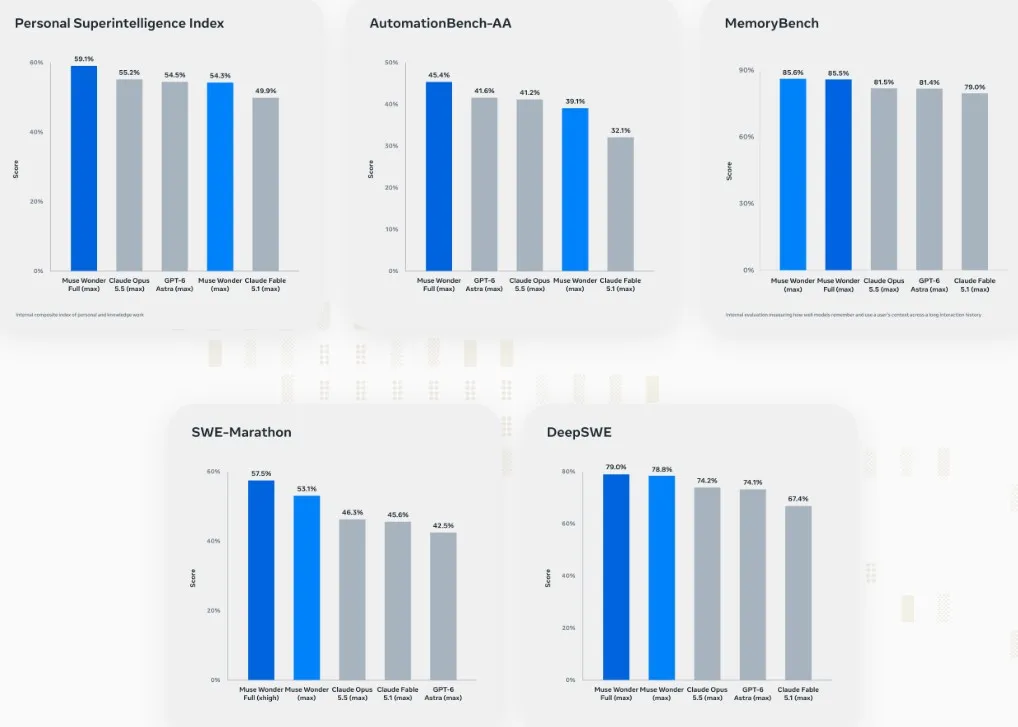
On frontier coding, Muse Wonder achieves state‑of‑the‑art pass rates on SWE‑bench Verified and HumanEval+ by combining repository‑scale context ingestion with tool‑augmented generation cycles that write, test, and iterate patches autonomously. The model supports speculative decoding for parallel patch proposals and integrates natively with Meta’s internal CI infrastructure, a capability the company says will roll out to external IDE plugins in the coming quarter.
These capabilities are summarized in a concise fact sheet that highlights the model’s specifications, performance, and pricing.
Key Facts About Muse Wonder
- Model variants: Muse Wonder (flagship) and Muse Wonder Lite (distilled, lower latency) available via OpenRouter.
- Context window: 128,000 tokens for both variants.
- Pricing (per 1M tokens): Muse Wonder at $3.00 input / $15.00 output; Muse Wonder Lite at $0.60 input / $2.40 output.
- Benchmarks: 92.7% on MMLU‑Pro, 72.4% on SWE‑bench Verified, and 89.1% on HumanEval+ for the flagship model.
- Multimodal support: native text, image, and structured data processing with tool‑use and function‑calling APIs.
- Deployment: serverless endpoints with per‑request Active Focus routing controls and speculative decoding for coding workflows.
Having outlined the core specifications, it is useful to understand how developers can actually obtain and use Muse Wonder, as well as the safeguards that accompany the service.
Availability, Pricing, and Safety Considerations
Developers can access Muse Wonder through the Meta Model API and the Muse Code environment, which provide serverless endpoints with per‑request controls for Active Focus routing and speculative decoding. Pricing follows a per‑million‑token structure: the flagship model runs at $3.00 for input and $15.00 for output, while Muse Wonder Lite is priced at $0.60 input and $2.40 output, positioning the lineup competitively against recent releases such as ChatGPT 5.2.
Safety tooling includes built‑in content filtering, configurable refusal thresholds, and audit logging for enterprise deployments. Meta also publishes model cards detailing red‑teaming results for cybersecurity, biological risk, and persuasion benchmarks, and requires acceptance of a responsible‑use addendum before production API keys are issued.
Frequently Asked Questions
How does Muse Wonder’s pricing per token differ from Muse Wonder Lite, and what should developers consider when estimating costs for large input versus output volumes?
Muse Wonder costs $3.00 per million input tokens and $15.00 per million output tokens, while the Lite variant is priced at $0.60 for input and $2.40 for output per million tokens. Because output is five times more expensive than input on the flagship model, workloads that generate long responses can quickly dominate the bill. Developers should therefore evaluate the expected output length and consider Lite for latency‑sensitive or lower‑cost scenarios.
What is the Active Memory feature in Muse Wonder and how can it be used to preserve context across separate API requests?
Active Memory provides a persistent, queryable key‑value cache that stores facts, preferences, and reasoning traces during inference, allowing the model to recall information without re‑sending the full conversation history. Developers can enable the cache via API flags and retrieve stored entries in later calls, which is useful for multi‑day research assistants or personalized agents that need to retain project‑specific knowledge across sessions.
How do Muse Wonder’s coding benchmarks compare to competing models like Google Gemini 3, and what does that mean for developers choosing a model for code generation?
Muse Wonder achieves 72.4% on the SWE‑bench Verified benchmark and 89.1% on HumanEval+, placing it at or above the state‑of‑the‑art performance reported for Gemini 3 in similar tests. This strong coding proficiency, combined with its speculative decoding and tool‑augmented generation, makes it a compelling choice for developers who need high‑quality, autonomous code patches, especially when integrated with IDE plugins or CI pipelines.
Last Updated on October 12, 2026 7:12 pm by Laszlo Szabo / NowadAIs | Published on October 12, 2026 by Laszlo Szabo / NowadAIs